Gas installation when buying: check before the CPCV
How to check inspection evidence, appliances, deadlines and responsibilities and prepare the gas handover before buying in Portugal.
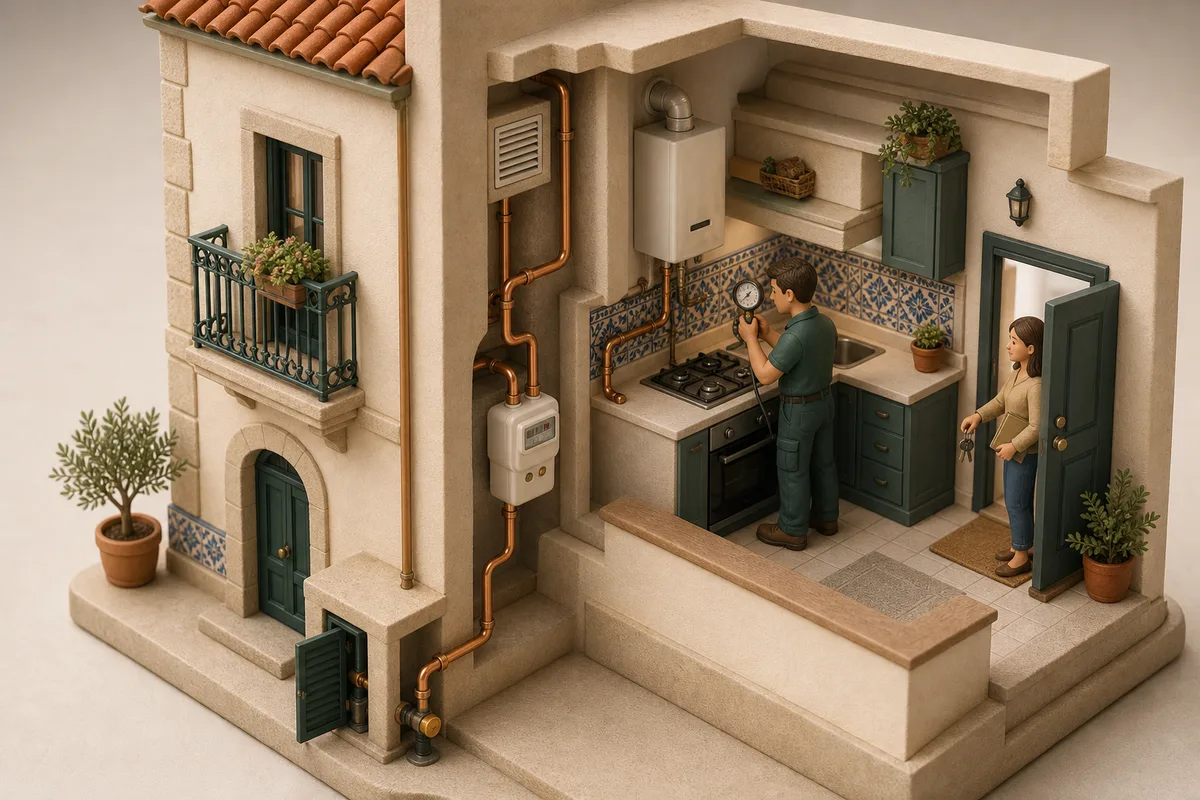
The hob lights during the viewing and the water heater appears to work. That shows gas is available at that moment; it does not show that the inspection declaration is valid, that appliances and ventilation still match the approved configuration, or that taking over the supply will be simple.
Before the CPCV, treat the gas installation as a small technical workstream: request the evidence, reconstruct later changes and decide who resolves each gap. The buyer should not test for leaks. The aim is to reach the deposit with a verifiable route to handover of both home and supply.
Key takeaways
- A flame or recent bill does not replace an approving inspection declaration or report applicable to the current installation and appliances.
- Changing the contract holder does not itself require extraordinary inspection — but the exemption depends on valid evidence, no relevant changes and no technical interruption.
- Only an authorised gas installer works on the installation; inspection belongs to an authorised gas inspection entity.
- In an apartment, the unit and common riser have different responsible parties. Locate the issue before assigning cost or timing.
Build the file before assuming the gas account transfers to you
Request four groups of information from the seller:
- Supply status: active, disconnected on request or interrupted for a technical reason. Record the supplier and, where relevant, network operator.
- Latest approving evidence: a valid inspection declaration or approving inspection report, with its date and issuer.
- Later interventions: conformity declarations issued by an authorised installer after alteration, repair or maintenance of the installation or appliances.
- Current configuration: each gas appliance, its location and the ventilation and combustion-exhaust systems serving it.
DGEG guidance says changing supplier or contract holder does not automatically require an extraordinary inspection. A simple takeover still assumes there was no technical interruption or inspection-triggering change and that valid approving evidence can confirm the relevant appliances, ventilation and exhaust were not replaced.
If the document is missing, do not leave the search until completion week. The DGEG FAQ says a duplicate can only come from the original issuer; DGEG does not reissue another entity's certificate or declaration. Identify the issuer and confirm early with the supplier, operator and an EIG which evidence and steps apply to the actual case.
Quick file before the CPCV
- Current supply status and reason for any disconnection or interruption
- Approving inspection declaration or report, date and issuer
- Conformity declarations for later interventions
- List and photographs of appliances included with the home
- Confirmation that grilles, ducts and exhaust were not altered
- Expected date of the next periodic inspection
- Common-riser status and condominium administration contact
Separate the installer, inspector, network and condominium roles
“Gas technician” can hide different functions. Always verify the entity on the current DGEG list.
| Entity | Function | Evidence to retain |
|---|---|---|
| EI — authorised gas installer | Executes, alters, repairs or maintains the installation and gas appliances. | Execution conformity declaration where applicable. |
| EIG — authorised gas inspector | Independently inspects visible parts, tightness, ventilation, appliances and shut-offs. | Inspection declaration stating approval, rejection, defects and limitations. |
| Operator/supplier | Manages the network, interruption/reconnection or supply contract, according to each entity's role. | Supply-point status and confirmed requirements for takeover or a new contract. |
| Condominium | Promotes maintenance and inspection of the common riser up to the unit meters. | Minutes, reports, interventions and timetable for the common installation. |
Use DGEG's authorised EI list to select the company doing the work and its authorised EIG list to select the inspector. Do not accept an informal repair or confuse a maintenance invoice with an approving inspection.
In a collective building, DGEG separates the common riser — from the external building valve to each unit's meter — from the internal installation running from the meter to the appliance valves. The condominium administration is responsible for the former; the owner or usufructuary is normally responsible for the latter. If a report records a defect, locate it across that boundary and read the condominium minutes before estimating cost or timing.
Read the inspection clock; do not guess from the home's age
For residential buildings, DGEG's current table distinguishes when the gas installation was executed:
- executed on or before 21 August 2018: first periodic inspection by 26 August 2028 or when the installation reaches 20 years, whichever is earlier;
- executed after 21 August 2018: first periodic inspection at 10 years;
- later periodic inspections: every five years.
An extraordinary inspection restarts the periodic clock from that date. It can be required after reconversion, specified pipe or component changes, a leak, or an interruption caused by a critical defect. The building's age is therefore not enough: request the execution and latest inspection dates and confirm the calendar with an EIG.
An approved installation can carry a short-lived limitation. DGEG states, for example, that a declaration mentioning an NG-1 defect is valid for only 60 days. Read the complete result; “approved” without conditions, date or annex is not a safe conclusion.
If the evidence and physical configuration do not reconcile, arrange an authorised check
The buyer should not block grilles to test ventilation, search for leaks with a flame or dismantle appliances. An EIG assesses visible parts, conducts a leak-tightness test and checks ventilation, appliances and shut-off devices. If work is needed, an EI intervenes and issues the applicable declaration; an inspection may then be required.
Request technical access before the CPCV when:
- no approving evidence can be recovered;
- gas is interrupted for an unknown or technical reason;
- an observed appliance, pipe, grille or exhaust does not match the file;
- the kitchen was remodelled, the water heater changed or a balcony containing an appliance enclosed;
- a report records an unresolved defect or limitation;
- the condominium reports pending work on the common riser.
The energy certificate, bank valuation and a general final inspection have useful but different jobs. None replaces this technical test.
If a step remains open, turn it into responsibility, deadline and consequence
Do not sign a CPCV saying only “gas in working order” if the parties still have to recover evidence, repair, reinspect or reconnect. With a Portuguese lawyer or solicitor, describe:
- the installation and appliances included in the sale;
- documents to be delivered and minimum agreed result;
- access for the EI, EIG, operator and buyer;
- who arranges and pays for repair, inspection and reconnection;
- a deadline before completion;
- what happens to timing and the deposit if the installation does not reach the agreed state;
- separate handling of unit and common-part defects.
Do not improvise technical contract wording from this guide. The purpose is to stop an unresolved fact becoming, after the deposit, an argument about who knew, who pays and whether completion waits.
At handover, compare the home with the approved file
During the final inspection, confirm the promised appliances remain installed, no recent work changed pipework, ventilation or exhaust, and final documents match the agreed result. Record the meter, reading, technical-cupboard keys and shut-off locations without manipulating the installation.
Arrange the account takeover or new contract in advance. If the operator or supplier requires an additional step, complete it before the keys change hands. Completion does not automatically find the issuer of a missing certificate or correct an informal alteration.
This regime concerns a piped gas installation in a building. An appliance fed directly by a cylinder placed at the point of use should not be treated as if it had exactly the same file; confirm the system, supplier and applicable safety rules separately.
Frequently asked questions
Does transferring the gas contract to the buyer require another inspection?
Will DGEG issue a duplicate missing certificate?
Can the seller use their usual plumber for repairs?
Who is responsible for pipework in an apartment?
Must a new Portuguese home have a gas installation?
This guide is general information, not an inspection or legal advice. Confirm the installation with DGEG-authorised entities, supply with the relevant sector entities and CPCV conditions with a Portuguese lawyer or solicitor.
More guides
August 7, 2026
Damp and water ingress: investigate before the CPCV
How to record signs, diagnose the source, check the condominium and require proof of repair before buying a home in Portugal.
August 5, 2026
Electrical installation when buying: check before the CPCV
How to check the electrical file, condition, power capacity and responsibilities before buying a home in Portugal.