Electrical installation when buying: check before the CPCV
How to check the electrical file, condition, power capacity and responsibilities before buying a home in Portugal.
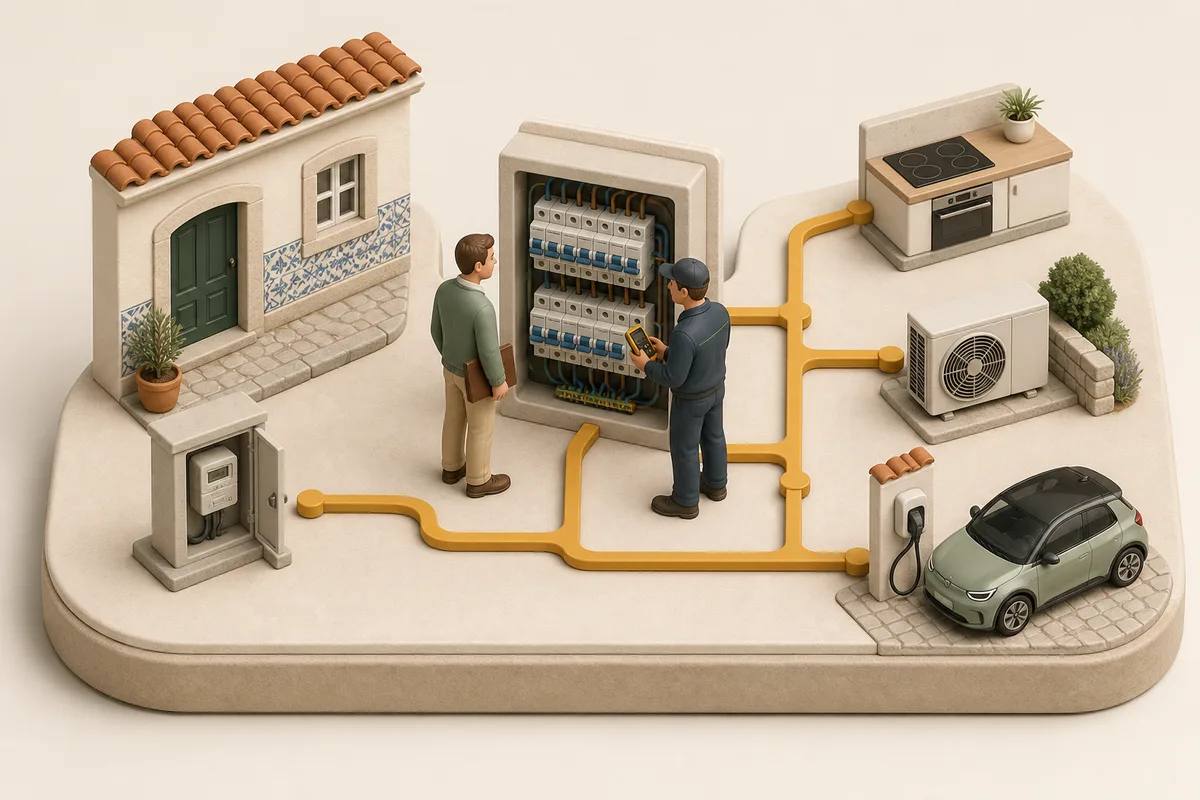
The lights work during the viewing and there is a recent bill. That confirms there has been a supply; it does not confirm the installation's present condition, the quality of later works, or the power available for the equipment you plan to use.
Before the CPCV, separate three questions: which installation is registered, what technical condition it is in, and what capacity it can deliver. One answer does not replace the others.
Key takeaways
- A CPE, bill and live supply identify the service; they are not a report on the electrical installation's condition.
- Ordinary low-voltage homes are exempt from periodic inspection. That exemption does not show that an old or altered installation remains suitable today.
- Contracted power and maximum admissible power are different limits. An electrification plan may still require work in the unit, building or network.
- Do not improvise electrical tests. Agree the scope with a qualified technician or entity and retain the report, measurements and evidence of corrections.
Build the file before looking inside the board
Start with the installation's identity and history. Ask the seller for:
- CPE and supply: Supply Point Code, supplier, latest bill, contracted power, tariff and current supply status.
- Available power: known maximum admissible power and single- or three-phase supply information where relevant.
- Execution file: electrical data sheet, conformity declaration or execution responsibility term, execution record and inspection declaration where applicable.
- Later changes: documents and invoices for a new board, circuits, kitchen, cooling, heat pump, solar, vehicle charging or renovations that affected the installation.
- Events: technical disconnections, recurring trips, dead sockets or circuits, abnormal heat, burning smells or repeated repairs.
The CPE uniquely identifies the installation; it is not a quality mark. Where a property has a meter or previously had a contract, E-REDES says the new holder will generally contract with a chosen supplier. Where it never had a meter or contract, a grid-connection process is needed. Confirm the route early: “change the name on the account” and “create or regularise the connection” are different jobs.
Quick file before the CPCV
- CPE, latest bill and current supply status
- Contracted power and maximum admissible power
- Electrical data sheet and applicable original execution evidence
- Inspection declaration where required or obtained voluntarily
- Documents and invoices for later alterations
- List of failures, disconnections and circuits that do not work
- Plan for new equipment with material electrical loads
- Condominium information on common risers, boards and garage
The periodic-inspection exemption is not a condition guarantee
A home supplied in low voltage will normally have a type-C installation. The current DGEG FAQ separates two important ideas:
- a residential installation at or below 6.90 kVA is exempt from initial inspection, although its operator can request an inspection;
- ordinary low-voltage homes are exempt from mandatory periodic inspections.
Above that residential threshold, DGEG gives 10.35 kVA and 13.8 kVA examples requiring inspection and routes the process through an electrical installation inspection entity, or EIIEL. The precise file depends on the date, power, intervention and applicable regime. Do not infer it from a document's appearance or ask the seller for a generically named “electrical certificate”.
The practical consequence of the periodic exemption is simple: a decades-old home may never have undergone a mandatory periodic inspection. That does not prove a defect, but it does not update the installation's condition either. The legal regime requires installations to be maintained for safe operation and use. An original execution document does not, on its own, describe everything that happened later.
| Item | What it confirms | What it does not confirm |
|---|---|---|
| Bill or contract | Commercial relationship, CPE, consumption and stated contracted power. | Condition of board, circuits, earthing or protective devices. |
| Execution evidence | Declared responsibility and compliance for identified work and configuration. | Later alterations or present condition without a new check. |
| Inspection declaration | Result and deficiencies within the inspection's scope and date. | Later work or future loads that were not assessed. |
| Pre-purchase assessment | Observations, tests and limitations included in the agreed scope. | External feasibility still dependent on building, supplier or network. |
Commission a technical assessment with scope, measurements and limits
Do not open the distribution board, remove socket plates or improvise tests. Record only what you can observe without touching: meter and board location, visible signs, existing equipment and the seller's account. Then give the check to a qualified professional or entity.
DGEG distinguishes installation entities, responsible technicians and inspection entities with different roles. An EIIEL conducts a regulated inspection. An installation entity or responsible technician executes and documents work within their competence. Verify current registration and ask the proposal to state whether it is a condition assessment, regulated inspection, repair or certification of an intervention.
Agree the pre-purchase scope in writing. Depending on the home and professional, it may cover:
- identification of the board, circuits and protective devices;
- applicable tests and measurements protecting people and property;
- condition of sockets, fixed connections and wet areas;
- consistency between observed circuits and documented alterations;
- signs of overheating, improvised connections or damaged components;
- capacity and works needed for the loads you plan to add;
- access limitations, common parts and items requiring more investigation.
Request a written result with photographs, measurements, limitations and priorities. If the professional identifies a serious anomaly or danger, follow their and the competent entities' instructions immediately; do not keep the installation energised merely to protect the purchase timetable.
Test the power plan before promising yourself an all-electric home
Contracted power on the bill is the commercial tier available at that moment. Maximum admissible power is the registered technical ceiling for the installation. Neither alone proves that the board, circuits, building riser or service connection can support the desired transformation.
List equipment you expect to operate together: induction hob, oven, water heater, heat pump, air conditioning, dryer, pool or vehicle charger. Give the list to the technician to size the solution; do not simply total the catalogue ratings yourself.
E-REDES says an increase within maximum admissible power is requested from the supplier. Above that limit, the request goes through E-REDES and may require certification for the new value, a network contribution or construction of connection elements. In an apartment it may also depend on the common riser and board. Establish feasibility, works and cost before treating electrification as certain.
Separate the unit, condominium, supplier and network
The boundary matters in a detached home and becomes essential in an apartment building. Ask the technician to locate each limitation and identify who controls and is responsible for each part.
| Part | Question before the CPCV | Likely counterpart |
|---|---|---|
| Unit installation | Which corrections and documents are missing inside the home? | Seller, buyer and qualified professional. |
| Common installation | Does the riser, common board or garage limit power or work? | Condominium administration and building technician. |
| Supply contract | Which power and offer will be contracted for the CPE? | Chosen supplier; compare through ERSE. |
| Grid connection | Does the request exceed admissible power or change the connection? | Distribution operator, normally E-REDES on the mainland. |
Read the condominium minutes if your plan touches common parts. A technician saying the unit is ready is not condominium authorisation or confirmation of riser or network capacity.
Turn every open item into access, responsibility and consequence
If assessment, repair, inspection, paperwork or a power increase remains open, avoid the vague promise “electrical installation in working order”. With a Portuguese lawyer or solicitor, address in the CPCV:
- the file and report to be delivered;
- access for the buyer and professionals before completion;
- agreed anomalies and works, minimum result and completion evidence;
- who arranges and pays for assessment, repair, inspection or certification;
- dependencies on the condominium, supplier and network operator;
- deadline and effect on timing and deposit if the result is not achieved;
- fixed equipment, charger, solar equipment or other items included in the sale.
At the final inspection, compare the installation with the report: board, included equipment, identified circuits and evidence of corrections. Record the meter reading and prepare the new contract using the CPE. Do not accept a last-minute alteration without knowing who carried it out and what document they left.
Frequently asked questions
Does a home require mandatory periodic electrical inspection?
Does an active electricity supply prove the installation is safe?
What is the difference between contracted and maximum admissible power?
Can I make a new contract if the home already had electricity?
Does the mortgage valuation inspect the electrical installation?
This guide is general information, not an inspection or legal advice. Confirm technical scope with qualified professionals and entities, connection and power with the relevant sector bodies, and the CPCV with a Portuguese lawyer or solicitor.
More guides
August 7, 2026
Damp and water ingress: investigate before the CPCV
How to record signs, diagnose the source, check the condominium and require proof of repair before buying a home in Portugal.
August 4, 2026
Gas installation when buying: check before the CPCV
How to check inspection evidence, appliances, deadlines and responsibilities and prepare the gas handover before buying in Portugal.