Damp and water ingress: investigate before the CPCV
How to record signs, diagnose the source, check the condominium and require proof of repair before buying a home in Portugal.
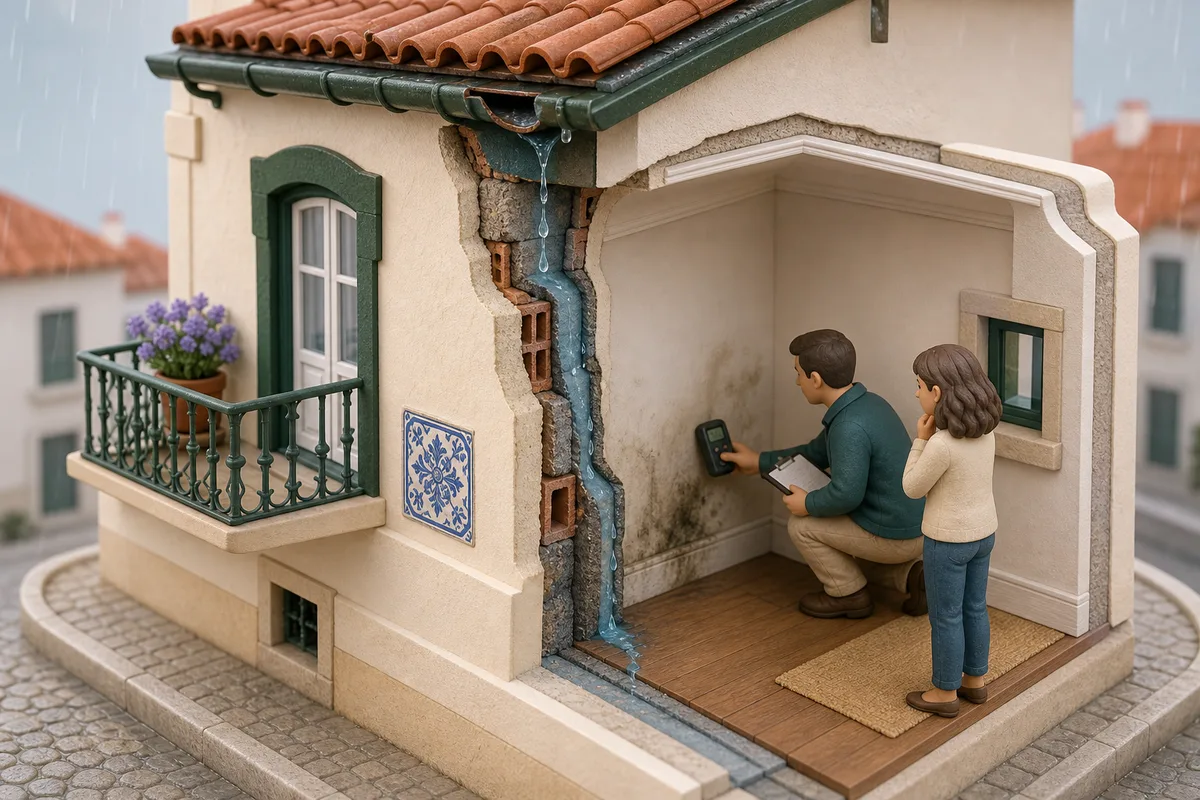
A dark mark, recent paint or a musty smell justify questions, but do not identify the source of the water on their own. Condensation, a plumbing leak, rain through the roof or facade, and moisture from the ground require different investigations and repairs.
Before the CPCV, turn the visible sign into a verifiable process: record what you saw, reconstruct the history, locate the likely source with technical help, identify who controls the affected area, and define the evidence that closes the issue.
Key takeaways
- A stain is evidence of a condition; it is not a diagnosis of the cause.
- Ventilation helps control indoor moisture, but it does not repair a leak, roof or facade.
- In an apartment, the source may be in the unit, another unit or a common part. Locate it before allocating cost.
- A repair is demonstrated by its scope, work evidence and later verification — not by new paint alone.
Read the sign without turning a viewing into a diagnosis
With permission, photograph the location and extent. Record smell, texture, loose finishes, salt deposits, swollen timber, degraded sealant, and paint with a different colour or sheen. Look at the outside and adjacent rooms too, without removing materials or entering areas you are not authorised to access.
Ask about the weather in the preceding days and whether the home was vacant, closed or heated. A viewing after weeks of dry weather may miss a problem that appears with rain; a vacant home also does not reproduce moisture from showers, cooking and drying laundry.
| Observation | Possibilities to investigate | Limit of the observation |
|---|---|---|
| Mould in cold corners or behind furniture | Condensation, thermal bridging, insufficient ventilation or heating; water ingress may also be possible. | The visible pattern alone cannot separate occupation, construction and ingress. |
| Mark that worsens with rain | Roof, gutter, terrace, facade, window or construction junction. | Water can travel through the assembly and emerge far from its entry point. |
| Damp area beside a kitchen or bathroom | Pipework, waste, seal, waterproofing or condensation. | Proximity does not prove that room's installation is the source. |
| Low mark beside the floor | Ground moisture, leak, facade, exterior paving or an incomplete earlier repair. | Salt deposits and stain height are not enough to classify the source. |
Portugal's Directorate-General of Health connects damp and mould with several possible causes: occupants' behaviour, overcrowding, construction characteristics, structural failures and inadequate ventilation. The useful conclusion is to investigate the system, not select the most convenient explanation during the viewing.
Reconstruct the history before accepting “it was repaired”
Ask for dated answers and records. The goal is not a perfect photo archive; it is a coherent sequence from occurrence to diagnosis, work and verification.
Damp file before the CPCV
- Date and conditions in which each problem appeared
- Photographs taken before painting or repair
- Technical reports, readings and recorded limitations
- Invoices and exact description of completed work
- Warranties, contractor contacts and proof of payment
- Insurance claims and decisions, without assuming future cover
- Messages with neighbours and the condominium manager
- Minutes, quotations and resolutions on the roof, facade, terrace or pipes
- Dates of repainting, replacement of finishes and any recurrence
Compare the seller's account with minutes and invoices. “It was waterproofed” should let you answer where, with what preparation, by whom, when, and with what later result. Work confined to the interior may have treated the visible damage rather than the source.
Portugal's RJUE requires conservation at least once in each eight-year period and all work needed for safety, health and appearance regardless of that interval. The rule does not prove that a particular building was maintained and does not replace its actual history. A municipality can also order work where safety or health conditions are poor; ask about notices and proceedings if the signs or minutes point to them.
Get a technical diagnosis with a defined scope and limits
Choose an independent professional experienced with the building type and the suspected pathology. Before the visit, send photographs, available plans, history and questions. The proposal should state which areas will be observed, which instruments or tests may be used, which access depends on the seller or condominium, and what written deliverable you will receive.
An investigation may combine:
- visual inspection of the unit, exterior and accessible adjoining areas;
- comparative moisture readings in materials and reference areas;
- indoor temperature and relative-humidity records;
- thermal imaging where conditions and the question make it useful;
- targeted roof, drainage, plumbing or waterproofing tests;
- a local opening or monitoring over time where authorised and necessary.
No instrument removes the need for interpretation. A thermal camera shows temperature differences, not an automatic “water” label. A moisture meter responds to the material, method and conditions. Ask the report to separate observations, the most likely explanation, alternatives, limitations, further tests and priority. LNEC's work on building inspection and diagnosis illustrates the need for both global and detailed assessment where damp marks and water ingress are found.
The bank's valuation assesses the property securing the loan. Banco de Portugal confirms that the buyer is entitled to the report. Read it, but do not treat it as a scoped damp diagnosis. If the source and cost matter to your decision, commission that investigation separately.
Locate the source before deciding who pays
In an apartment, do not accept the automatic answer “the condominium pays” or “it is inside the unit”. Civil Code article 1421 includes the structure, roof or roof terraces and general water installations among common parts. The constitutive title may allocate exclusive use of certain common areas to one owner. Private pipework, work in one unit or a common element can therefore produce different scenarios.
Ask the professional to identify the likely path and required access. In parallel, ask the manager for:
- minutes and messages about ingress on the same stack, facade or roof;
- reports, quotations, awarded work and warranties;
- budget, reserve fund and extraordinary contributions;
- resolutions already passed and work still awaiting a vote;
- insurance claim and the response received;
- access to the roof, terrace, plant room or risers where needed.
Civil Code article 1424 sets the allocation rules for common-part conservation expenses and links liability for charges to the owners at the time of the relevant resolutions, subject to the statutory exceptions. A 2024 judgment treated ingress caused by roof drainage, waterproofing and exterior walls as common-part pathologies for the condominium to eliminate. It is a useful example, not a universal answer to every stain.
Read our guide to condominium minutes. At completion, the manager's statement under article 1424-A must identify current charges and debts for the unit. Do not waive it without advice: condominium charges falling due after transfer are generally the new owner's responsibility.
Cost the full sequence and define verification
A useful quotation does not end at “paint wall”. It should follow the technical logic of the case: stop the source, correct defective materials or construction details, allow the necessary drying, treat or replace affected finishes, and verify the result. Duration and method depend on material, depth, season, ventilation and cause; question a generic deadline without a diagnosis.
Ask each proposal to separate:
- investigation and access;
- repair of the source;
- damage inside the unit and protection of contents;
- drying, removal or treatment of materials;
- reinstatement of finishes;
- verification after rain, system use or an agreed period;
- final report, photographs, invoices and warranties.
DGS recommends ventilation and preventing ingress in its indoor-air guidance. Ventilation remains important, but it does not replace repair of water entry. For extensive mould, symptoms or vulnerable occupants, seek suitable health and remediation advice; do not disturb materials before understanding the extent and risks.
Put the uncertainty in the CPCV before bringing the water home
If access, diagnosis, a resolution or work remains outstanding, deal with it before signing or make the CPCV reflect that uncertainty. With a Portuguese lawyer or solicitor, define:
- access for the buyer, professionals and contractors to the necessary areas;
- the report or test to be delivered and who commissions and pays for it;
- the defect and agreed work, avoiding vague phrases such as “resolve damp”;
- condominium approvals and cooperation required from the seller;
- a cost ceiling, retention or other legally suitable protection;
- deadlines and the effect on the deposit and completion if the result fails;
- evidence of completion and the condition for reinspection;
- disclosure of new events between the CPCV and completion.
Do not draft the clause from this guide alone. The source may cross several properties, and a vague promise can transfer risk without transferring control. See our CPCV guide, then conduct the final inspection with the report, photographs and works list.
Frequently asked questions
Does new paint mean the damp was resolved?
Can a moisture meter tell where the water comes from?
If the mark is on an outside wall, does the condominium always pay?
Should I revisit when it is raining?
Will the bank valuation detect water ingress?
This guide is general information, not a diagnosis, quotation, or legal or medical advice. Confirm the source and repair with qualified professionals, the condominium position with the manager and legal adviser, and the CPCV with a Portuguese lawyer or solicitor.
More guides
August 5, 2026
Electrical installation when buying: check before the CPCV
How to check the electrical file, condition, power capacity and responsibilities before buying a home in Portugal.
August 4, 2026
Gas installation when buying: check before the CPCV
How to check inspection evidence, appliances, deadlines and responsibilities and prepare the gas handover before buying in Portugal.