Noise before buying in Portugal: map, visits and test
How to read noise maps, visit at the right times, check the building and protect the CPCV before buying a home in Portugal.
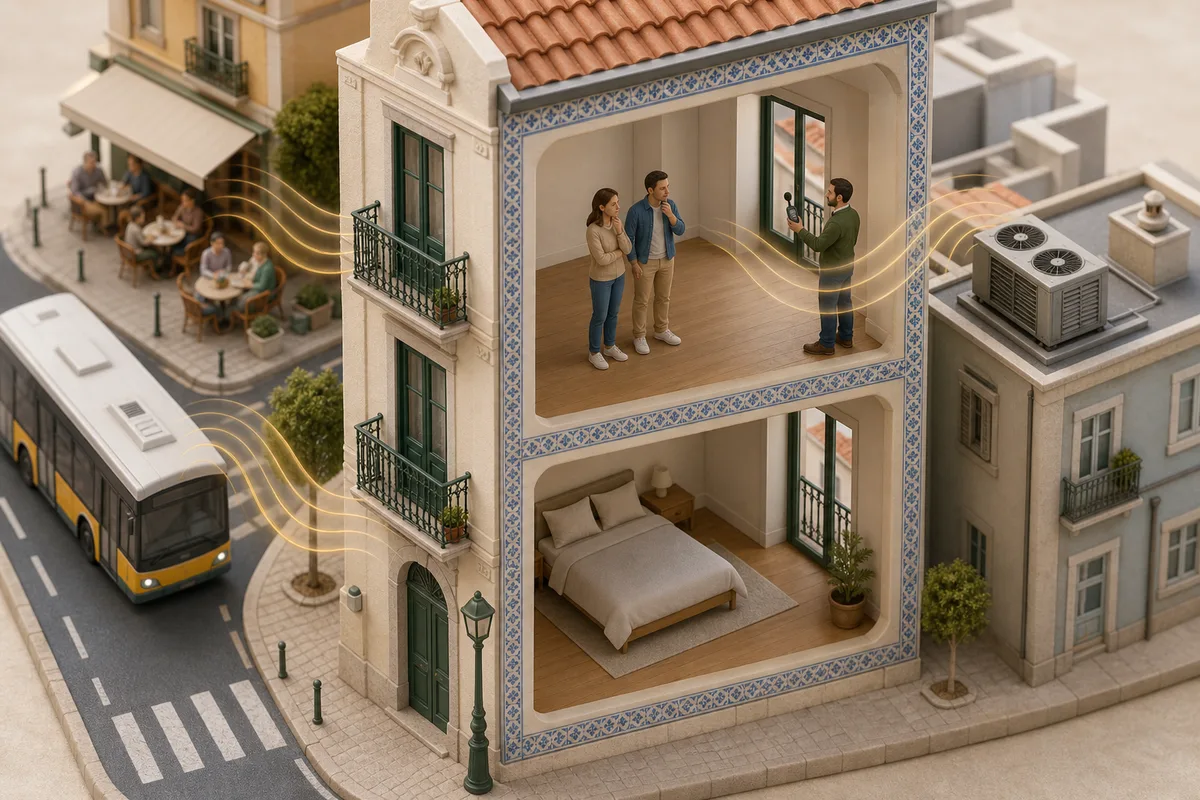
A quiet viewing at 11 a.m. can become a bedroom with traffic at 7 a.m., deliveries at 11 p.m. or impact noise from the floor above. After completion, finding the source and implementing the right solution can be expensive — and some sources are not even inside the apartment.
Before the CPCV, use a simple sequence: map to locate risk, visits to observe the pattern, documents to understand the building, and a technical test when the decision still depends on noise.
Key takeaways
- The municipal map describes long-term outdoor environmental noise; it does not measure the current sound inside that bedroom.
- Repeat the viewing at relevant times, with windows open and closed, and identify each likely source.
- If the transaction depends on the result, define access, testing, timing and consequence before paying a substantial deposit.
Start with the map — without turning it into an apartment certificate
Portugal's Environment Agency (APA) explains that municipalities prepare municipal noise maps and, where needed, reduction plans. Search the council website, the municipal plan and APA's map service for the home's address.
Read both layers. Lden is a long-term average weighted across day, evening and night. Ln represents night, from 11 p.m. to 7 a.m. Also check the reference year, descriptive report, included sources and any action or reduction plan.
The General Noise Regulation sets limits according to municipal classification. As a baseline, a mixed zone uses 65 dB(A) for Lden and 55 for Ln; a sensitive zone uses 55 and 45. There are special cases, including around major infrastructure, and rules for places not yet classified. Check the map and Article 11 rather than applying an isolated number.
| Evidence | What it answers | Limit |
|---|---|---|
| Lden/Ln map | Long-term outdoor exposure and modelled sources in the area. | It does not measure inside the unit or every current event. |
| Repeated visits | Audible patterns during the observed times and in the rooms visited. | It is a short sample dependent on day and conditions. |
| Acoustic test | The question, source and indices defined in the commissioned scope. | It does not answer what was outside the scope or period. |
Visit when the future home is actually in use
Do not let the seller choose the entire sample. Return during a weekday rush hour, at night and, where hospitality, tourism, sport or leisure is nearby, at a relevant weekend time. Consider school holidays, events and seasonality where they matter to the location.
During each visit, remain quiet for several minutes in the main bedroom and living room. Repeat with windows open and closed. Operate shutters, use the existing ventilation and walk through the common areas. The purpose is not to produce an official decibel value: it is to discover when, where from and by which path sound arrives.
Record time, room, window position, likely source, duration and character: continuous, impulsive, tonal or impact. A phone app may help maintain a consistent diary, but it does not replace a calibrated meter, method and competent specialist.
Listening route before the CPCV
- Road traffic, rail, aircraft, braking and horns
- Terraces, music, deliveries, waste collection and loading
- Voices, television and airborne sound through walls, doors or ducts
- Footsteps, chairs and dropped objects transmitted through the structure
- Lift, garage gate, pumps, extraction, ventilation and air conditioning
- Courtyard, stairs, garage, storage and the main bedroom facade
Separate the source from the path into the bedroom
“Replace the windows” is not a diagnosis. Outdoor noise can pass through glass, frames, shutter boxes, grilles and air inlets. A television may travel through the party wall or structural flanking paths. Footsteps and machinery can arrive through slabs, walls and mountings.
That distinction changes the work and cost. A good window does not correct impact from the ceiling. Decorative lining does not solve equipment rigidly connected to the structure. Sealing every air path may create a ventilation problem. Ask the specialist to find the dominant route before proposing a solution.
The Building Acoustic Requirements Regulation includes, within its scope, requirements for facades, separation between spaces, impact sound and building equipment. Application depends on the type and date of the building operation. Do not assume an older home has a report, or that meeting a legal minimum guarantees your preferred comfort.
Cross-check your ears with the council and condominium files
For covered works, request any acoustic design, declarations or evaluation and compare the completed unit with the approved work. If windows, floors, walls or commercial uses changed, check planning control, condominium approval where applicable and evidence of the installed solution.
For an apartment, read the condominium minutes and ask the manager in writing about:
- noise-related complaints and interventions;
- lifts, gates, pumps, extraction and HVAC;
- operating times, maintenance, quotations and approved works;
- relevant changes of use or work in other units;
- condominium rules for works and use of common parts.
On the street, identify businesses, loading bays, waste containers, schools, venues, workshops and transport. Ask the council about licensed uses, noise files open to consultation and future projects. Lisbon municipality, for example, publishes global and road maps, reports and monitoring; other councils organise and update their material differently.
If you need measurement, commission the question — not just “a test”
First state what could change your decision: outdoor night noise in the bedroom, facade insulation, separation from a neighbouring unit, impact from above or a specific piece of equipment. The specialist should propose suitable rooms, positions, periods, operating conditions, indices and limitations.
For formal tests, use IPAC's test-laboratory search. Open the provider's record and verify that its current accreditation scope includes the required test — having “acoustics” in a business name is not enough.
Give the specialist the map, plans, visit diary, suspected source and the decision you need to make. Request a report identifying the unit, rooms, equipment, method, conditions, results and limitations. Where work is proposed, require diagnosis, solution, ventilation, loss of space, cost and a way to verify the result afterwards.
Give the result a consequence before signing
A vague condition “subject to noise” defines nothing. If a decisive visit, document or test remains outstanding, settle access and timing before paying a substantial deposit.
Ask a Portuguese lawyer or solicitor to adapt the CPCV. Depending on the transaction, define:
- areas, equipment and times accessible to the buyer and specialist;
- test, professional, report and acceptable deadline;
- who pays for tests, opening-up, reinstatement and any design work;
- which result leads to work, another decision, adjustment or no completion;
- scope, materials, ventilation, deadline and evidence for agreed work;
- treatment of the deposit if the condition is not satisfied.
Do not assume that an unfavourable map, old complaint or uncomfortable result automatically cancels the transaction. Nor should you accept an oral promise that “the condominium will fix it”. Turn uncertainty into evidence, cost, timing, responsibility and a written consequence.
Frequently asked questions
Does being below the legal limit guarantee a quiet home?
Should I read Lden or Ln?
Can a phone app serve as evidence?
Will new windows solve every noise problem?
Can I require a test before the CPCV?
This guide is general information. Confirm maps and files with the municipality, diagnosis and testing with competent specialists, and transaction consequences with a Portuguese lawyer or solicitor.
More guides
August 7, 2026
Damp and water ingress: investigate before the CPCV
How to record signs, diagnose the source, check the condominium and require proof of repair before buying a home in Portugal.
August 5, 2026
Electrical installation when buying: check before the CPCV
How to check the electrical file, condition, power capacity and responsibilities before buying a home in Portugal.