Cracks before buying in Portugal: investigate first
How to record cracks, request history and diagnosis, check condominium and planning records, and protect the CPCV before buying.
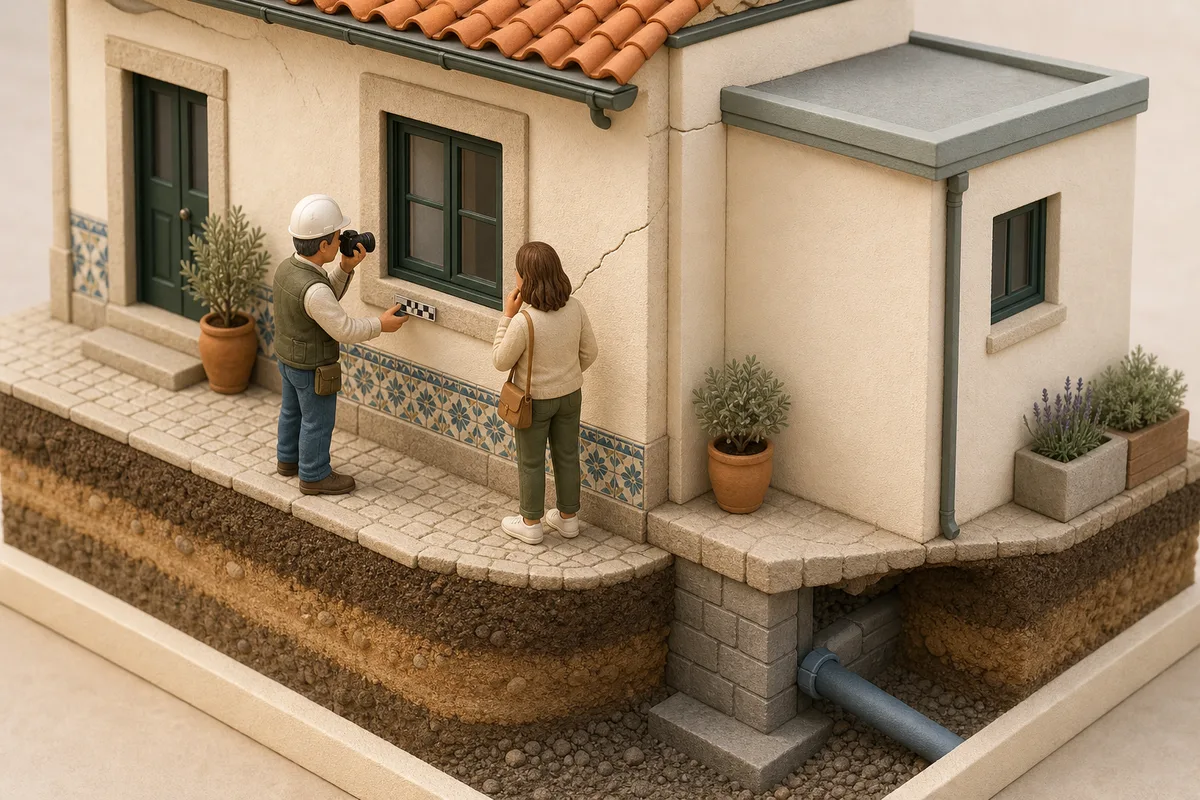
A crack beside a window may be limited to the finish — or point to a cause that needs diagnosis, work and a budget. A viewing photograph cannot distinguish between them. It also cannot tell you whether movement has stopped, a previous repair failed or, in an apartment, the source lies inside the unit or in a common building element.
Before the CPCV, turn the doubt into a verifiable sequence: record the pattern, reconstruct its history, commission the right technical question, cross-check the building against its records and give the result a consequence in the transaction.
Key takeaways
- A crack, sloping floor or sticking door is an observation; none proves a cause or severity by itself.
- Request history and a report, not just fresh paint or a verbal claim that “the house settled years ago”.
- If the purchase depends on the diagnosis, settle access, scope, timing, cost and consequence before paying a substantial deposit.
Observe the whole pattern — without turning it into a diagnosis
Start with a photograph of the whole room or elevation, then take the detail. Record the date, location, element, direction and visible extent. Note staining, repairs, fresh paint, distortion and whether the sign continues on the other face, the floor above, the facade or a common area.
Operate doors and windows; observe floors, ceilings, junctions between different construction periods and connections to balconies, roofs or walls. For a house, include the plot, drainage, gutters, visible foundations, retaining walls and outbuildings. For an apartment, walk through stairs, landings, garage and facade where access is available.
Do not use an internet table to label a crack “structural” from its width or direction. Material, geometry, history, loads, water and previous interventions change the interpretation. LNEC explains that corrective treatment of cracking should be supported by diagnosis of its causes and a detailed survey of anomalies.
Observation map for the second viewing
- Wide and detail photographs with identifiable date and location
- Windows, doors, floors, ceilings and wall junctions
- Similar signs on the other face, floor, facade or common area
- Patches, local paint, mesh, sealant or repeated repairs
- Damp, gutters, drainage, ground and retaining walls
- Junction of the original building with an extension, enclosed balcony, outbuilding or balcony
Reconstruct a timeline the viewing cannot show
Ask the seller in writing when the sign appeared, whether it changed and who assessed it. Request old photographs, reports, readings, invoices, warranties, repair designs, insurance claims and correspondence with the council or condominium. A documented intervention is more useful than “it was fixed”.
Look for sequence: did it appear after work, a leak, burst pipe, nearby excavation or drainage change? Was it only filled and painted, or was the cause treated? Did it reopen? Was it monitored, with a written conclusion? Missing dates or records are uncertainty to resolve — not evidence that the problem is either minor or severe.
LNEC's study on building inspection and diagnosis highlights preliminary recognition, conservation and safety condition, and building history before defining an intervention. For a buyer, that discipline prevents pricing paint while the cause is still unknown.
Commission the specialist, scope and report — not merely “a survey”
If the answer could change the purchase, look for an independent civil or structural engineer with relevant experience in the construction system and anomaly. Verify identity and professional registration; gov.pt describes registration with the Ordem dos Engenheiros, but registration alone does not replace experience, independence and a defined scope.
Send the plans, photographs, history, works and decision questions before the visit. Ask the proposal to identify accessible areas, limitations, deliverable and possible next stages. An initial inspection may recommend monitoring, measurement, opening-up, ground or drainage investigation, or another specialist. That is more useful than false visual certainty.
| Evidence | What it answers | What it does not replace |
|---|---|---|
| Viewing observation | Where the sign is, how it presents and which questions it opens. | Diagnosis of cause, activity, safety or repair. |
| Technical report | Inspected scope, hypotheses, limitations and next steps defined by the specialist. | Planning records, legal decision or anything outside its scope. |
| Bank valuation | Property value for the credit and collateral process. | A structural investigation commissioned by the buyer. |
Request a report that identifies the property, areas seen and not seen, records received, observations, hypotheses, limitations, urgency and recommended investigation. If it proposes work, ask which cause it treats, the design, cost, access, timing and how success will be verified — not only how the finish will look.
For a house, investigate the system; for an apartment, investigate the condominium too
For a house, the problem boundary may include foundation, ground, drainage, roots, retaining wall, roof or an extension behaving differently from the original building. The specialist needs enough context not to isolate the crack from water, soil or adjacent work.
In an apartment, the interior location does not decide responsibility. Civil Code Article 1421 defines the soil, foundations, columns, pillars, load-bearing walls and the remaining building structure as common parts, along with the roof and other listed elements. Diagnose the source and cross-check the title and building regime before deciding that the defect or cost belongs to the unit.
Read the condominium minutes and ask the manager for reports, complaints, insurance, earlier work, quotations, resolutions, reserve fund and special assessments. Look for the same pattern on the facade, stairs, garage and adjacent units with permission. A promise that “the condominium will handle it” does not replace a documented decision, funding and schedule.
Cross-check the diagnosis against plans, the council file and bank valuation
Compare the real property with plans and permissions, especially around removed walls, new openings, outbuildings, enclosed balconies, extensions and retaining walls. RJUE Article 110 provides for municipal information and, for people who prove a legitimate interest, consultation of files and copies. Ask the council how to identify the file, demonstrate interest and request the necessary documents; channels and archives vary by municipality.
The file may show architecture, specialties, alterations and declarations, but historic approval does not certify current condition or explain a crack by itself. Similarly, unlicensed work may create a planning issue alongside the technical diagnosis.
Do not wait for the mortgage valuation to carry out this investigation. Law 153/2015 regulates property valuers serving entities in the financial system. That valuation serves the value and collateral process; it is not the structural report commissioned to answer the buyer's questions.
Before the CPCV, turn the result into an executable decision
If a decisive inspection, access, document or quotation is missing, try to resolve it before paying a substantial deposit. Where timing does not allow that, ask a Portuguese lawyer or solicitor to adapt the CPCV to that investigation. Do not assume there is a standard inspection condition or an automatic right to walk away.
Depending on the transaction, define:
- who gets access, accompanied by whom, to which areas and by what date;
- professional, scope, documents, report and follow-up investigation;
- who pays for inspection, opening-up, reinstatement, monitoring and design;
- which result or cost triggers work, renegotiation or no completion;
- specification, responsible party, deadline, warranty and verification of agreed work;
- destination of the deposit and other effects if the defined condition fails.
Do not buy an explanation; buy a chain of evidence. Where cause, cost, access or responsibility remains uncertain, that risk should appear in the decision, price, timing and contract — or justify not proceeding.
Frequently asked questions
I saw a crack. Should I walk away immediately?
Can a photograph or width identify a structural crack?
Will the bank valuation detect the problem?
Is a crack inside an apartment always the unit owner's problem?
Who pays for the inspection and any repair?
This guide is general information. Confirm the diagnosis with a competent professional, the file with the council and condominium, and the transaction effect with a Portuguese lawyer or solicitor.
More guides
August 7, 2026
Damp and water ingress: investigate before the CPCV
How to record signs, diagnose the source, check the condominium and require proof of repair before buying a home in Portugal.
August 5, 2026
Electrical installation when buying: check before the CPCV
How to check the electrical file, condition, power capacity and responsibilities before buying a home in Portugal.