Radon when buying in Portugal: map, test and plan
How to use Portugal's APA map, measure radon, interpret 300 Bq/m³ and verify remediation before buying a home.
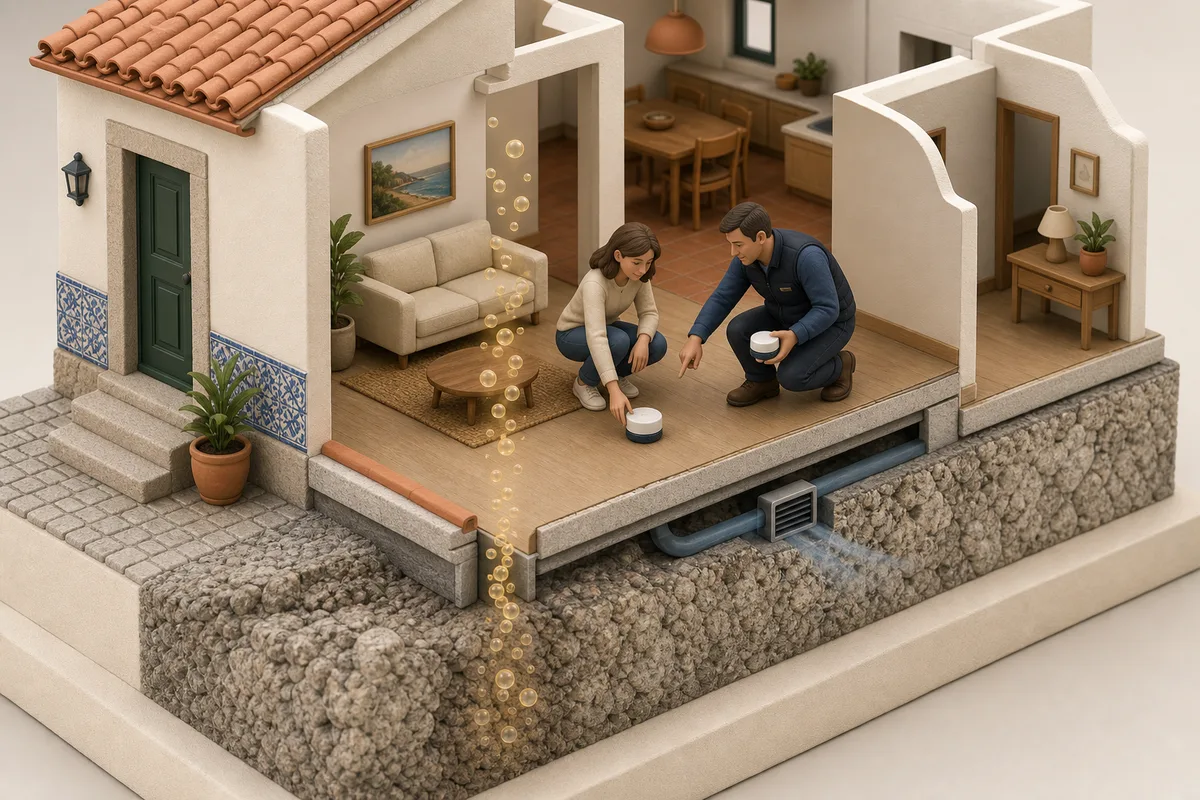
Radon has no colour or smell. A spotless viewing, valid energy certificate and favourable bank valuation do not reveal the concentration of this radioactive gas inside a home.
Portugal has a public susceptibility map, but the map does not certify a property. To decide on evidence, separate three questions: where is the home, what was measured inside it, and what solution was verified?
Key takeaways
- The APA map shows area susceptibility; only a measurement answers for the specific home.
- A long measurement, between three months and one year, is APA's basis for comparison with Portugal's reference level.
- If the purchase timetable cannot fit the test, settle the condition, cost and response in the CPCV with legal support.
Start with what radon is — and what you cannot observe
Radon is a naturally occurring radioactive gas. It can enter buildings from the soil through cracks, floor-wall joints, service penetrations and other openings. Concentration depends on geology, but also construction, ground contact, ventilation and how the building is used.
Long-term exposure increases lung-cancer risk. The World Health Organization explains that risk rises with long-term concentration and is much greater when combined with smoking. This does not turn a reading into a medical diagnosis; it makes measurement and reduced exposure prudent decisions.
Decree-Law 108/2018 sets a 300 Bq/m³ reference level for homes, expressed as an annual average concentration. It guides protection and remediation. It is neither a guarantee of zero risk below that value nor an automatic approval or cancellation clause for a private purchase.
Use the map to ask questions, not deliver a verdict
Check the APA susceptibility map and identify the parish. A high class supports raising the issue early. A low class does not automatically end the enquiry, particularly for a home in contact with the soil, with a basement, little ventilation or major alterations.
APA itself warns that the map gives average indications for an area and must not predict the level in a building. Neighbouring homes can produce different results. The only way to know the concentration is to measure inside the property.
| Evidence | What it answers | What it does not prove |
|---|---|---|
| APA map | Average area susceptibility and priority for enquiry. | The concentration in this home or room. |
| Short measurement | A first indication under those days' conditions. | The annual average on its own. |
| Long measurement | A representative estimate for comparison with the national reference. | That the level stays unchanged after works or ventilation changes. |
Bring radon into the purchase before signing the CPCV
Ask the seller for every previous report. Do not accept only a number in a message. Confirm dates, duration, rooms, detector type, reporting organisation and how the home was used. If remediation occurred, request the technical design or scope, invoices, warranties, maintenance instructions and post-work test.
Casa Pronta lists the building technical file where one exists, evidence concerning the use licence or exemption, and the energy certificate among normal completion documents. It does not list a radon measurement. A file ready for completion therefore does not answer this indoor-air question.
Timing is the practical problem. A representative measurement can take at least three months while a reservation or CPCV may move in days. Before paying a substantial deposit, choose a route that fits the transaction:
Questions to settle before the CPCV
- Is there a complete previous report that still represents the home's current condition?
- Will the seller allow detectors to remain under normal-use conditions?
- Which rooms, including basement and ground-contact spaces, will be measured?
- Who selects and pays the provider, report and any confirmatory test?
- Will the purchase wait for the result or require a precise contractual condition?
- Who provides diagnosis, quotation, work and effectiveness testing if the value is high?
- Which approvals may be needed if the solution touches common parts?
If the result will condition the purchase, ask a Portuguese lawyer or solicitor to define the accepted test, deadline, access, threshold, evidence, remediation and consequence in the CPCV. Do not rely on a vague “subject to inspection” phrase or assume a right to withdraw after signing.
Measure with suitable duration, placement and reporting
APA's measurement guidance draws a clear distinction:
- long measurements, between three months and one year, allow an estimate of mean concentration and comparison with the reference level;
- short or instantaneous measurements give only a first indication and should not be the sole measurement;
- APA recommends passive detectors both for initial diagnosis and for verification after corrective work.
Choose a provider working under APA guidance. Request the number and placement of detectors, period, rules for doors, windows and ventilation, treatment of seasonal variation, laboratory, uncertainty and report contents in writing. A photograph of each device helps show that it stayed in the intended location.
Do not measure only the most convenient upstairs room. The plan should consider occupied bedrooms and living rooms, basements, ground floors and ground-contact spaces. For an upper-floor flat, do not conclude on your own that height removes the issue: WHO records that considerable concentrations can also occur above ground level.
Read the number as a technical decision, not a label
First check whether duration and method support the comparison. Then review the rooms, uncertainty and building conditions. A value near the reference may call for confirmation and professional analysis; a high value needs a plan proportionate to the concentration and entry routes.
| Result | Prudent next step | Avoid |
|---|---|---|
| No report or an excessively short test | Treat the evidence as incomplete and define a valid measurement. | Turning an instantaneous reading into an annual average. |
| Below 300 Bq/m³ | Keep the report and review after relevant works or changes. | Promising zero risk or permanent validity. |
| Above 300 Bq/m³ | Obtain diagnosis, solution, quotation, responsibilities and a new test. | Assuming automatic cancellation or accepting a verbal fix. |
If the report arrives during an already contracted purchase, send it to the technical professional and lawyer who know the property and CPCV. Changing the price, retaining money, delaying completion or terminating the contract needs a contractual basis or formal agreement; it is not an automatic consequence of the measured value.
Turn remediation into a verifiable deliverable
APA describes approaches including under-floor ventilation, soil depressurisation, membranes, sealing selected entry routes and improved ventilation. A combination is often needed. The correct design depends on concentration, foundations, floors, ventilation and real use of the home.
A useful quotation should identify:
- probable cause or entry routes and areas covered;
- solution, ductwork, grilles, fans and electrical supply;
- effect on noise, consumption, maintenance and finishes;
- common parts, facade, roof or basement affected;
- responsible party, price, deadline, warranty and final documents;
- effectiveness measurement after the work.
In a condominium, check the horizontal-property title and obtain advice on required approvals before promising a facade duct or work in a shared basement. A price without practical permission to deliver the design does not reduce the buyer's risk.
Measure again after the work. APA recommends repeating the test every five years, or sooner after work affecting ventilation or heating or a change of use. Active systems must operate continuously and be inspected and maintained.
Frequently asked questions
Does a low-susceptibility parish remove the need to test?
Does the energy certificate measure radon?
Is a test lasting a few days enough for the CPCV?
Does more than 300 Bq/m³ make the home illegal or cancel the purchase?
Will opening the windows solve it?
This guide is general information. Define clauses, consequences and transaction changes with a Portuguese lawyer or solicitor; define measurement and remediation with competent professionals for the specific building.
More guides
August 7, 2026
Damp and water ingress: investigate before the CPCV
How to record signs, diagnose the source, check the condominium and require proof of repair before buying a home in Portugal.
August 5, 2026
Electrical installation when buying: check before the CPCV
How to check the electrical file, condition, power capacity and responsibilities before buying a home in Portugal.