Property documents in Portugal: what to cross-check before the CPCV
How to compare the registry, tax record, plans, energy certificate and municipal file before signing a CPCV in Portugal.
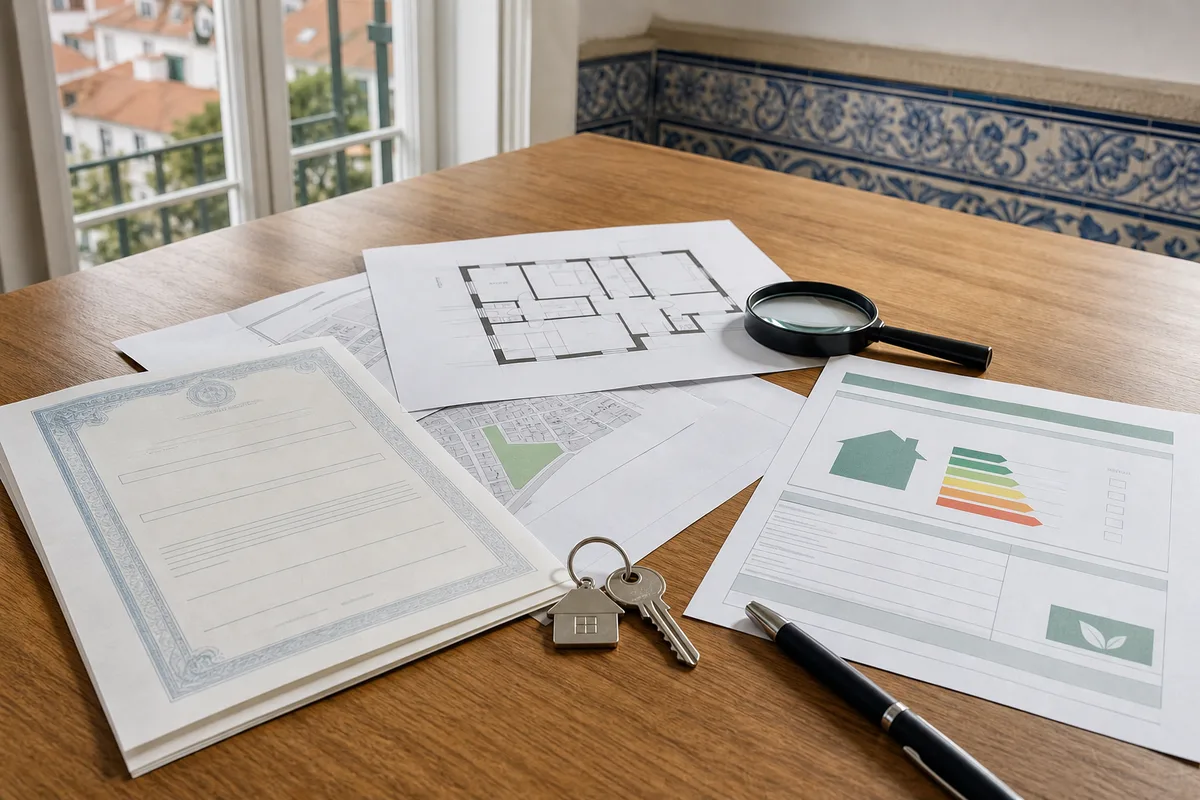
Before signing a CPCV, receiving "the documents" is not enough. The important question is whether all of them describe the same property: the land registry certificate, tax record, plans, energy certificate, municipal file and the home you actually visited.
When those documents do not match, a buyer may be paying for space that is not legally residential, an annex that is not regularised, the wrong unit, or a home with charges that have not yet been cleared.
Key takeaways
- Check that the registry, tax record, plans and energy certificate all refer to the same unit.
- The tax record is fiscal evidence; it does not prove every work, annex or use change is licensed.
- If important documents conflict, resolve or condition the issue before paying a large deposit.
The method: cross-check documents, not just PDFs
Think of the purchase as a consistency test. The listing says three bedrooms, 130 m² and garage. The certidão permanente do registo predial identifies the unit and legal charges. The caderneta predial shows the tax article, use and fiscal areas. The certificado energético gives a technical description. The plans and municipal file show what was approved or communicated. The viewing shows the physical reality.
Your job as buyer is to ask one simple question: do these versions tell the same story?
Which documents should you compare?
Ask for the documents early, ideally before accepting a CPCV with a tight deadline. Not every case needs the same depth, but these are the base checks for a normal purchase.
| Document | What it confirms | What to compare |
|---|---|---|
| Land registry certificate | Legal situation, owner, unit, mortgages, seizures and pending registry requests. | Seller name, description, fraction, garage, storage and charges. |
| Caderneta predial | Tax data: article, use, areas, taxable value and fiscal ownership. | Article, fraction, residential use, private and dependent areas. |
| Energy certificate | Energy class, assessed unit, systems and recommended improvements. | Address, fraction, areas, validity and whether it reflects the current home. |
| Plans and municipal file | Approved or communicated layout and relevant planning evidence. | Bedrooms, annexes, enclosed balconies, garage, attic, basement and outdoor areas. |
The land registry certificate is especially important because it shows active registrations and pending registry requests. A mortgage is common in a sale, but there should be a clear plan for repayment and cancellation at deed. Seizures, insolvency entries, usufructs, easements or long leases need analysis before you move forward.
The caderneta predial is useful too, but do not treat it as a planning licence. It identifies the property for tax purposes. If the home has annexes, a pool, a converted garage, enclosed balconies or extra area, check whether that reality also appears in the plans and municipal file.
Use, licence and plans after Simplex
This is the section where buyers should be most careful. Since 2024, the old obligation to present the use authorisation and housing technical file in transfer acts for urban properties no longer works in the same way. That does not mean urban-planning risk stopped mattering.
The practical buyer question is different: is there documentary support for the home to be used and sold as it stands? If the unit is sold as a home but the tax record, plans or municipal file point to services, storage, garage use or unregularised works, do not treat it as a detail.
In 2026, the planning regime was revised again. Because these rules have changed recently, confirm the specific case with a lawyer, solicitor, notary or municipal technical professional before signing if there is a material doubt.
Ask for an explanation before the CPCV if
- The seller cannot explain the licence, authorisation, planning title or exemption that applies.
- The home was renovated and the old plans no longer seem to match reality.
- An attic, basement, garage or storage room is being sold as living space.
- An enclosed balcony, annex, pool or private outdoor area is central to the price.
- The advertised area is much higher than the private area or available plans.
- The agent says it can be "legalised later" without a budget, timeline or technical opinion.
Red flags that should delay signing
Some discrepancies are simple: an old address, renamed parish or energy certificate that needs renewal. Others can affect value, financing or your ability to use the home as expected.
Delay signing if the seller is not on the registry certificate, not all owners are involved, there are pending registry requests nobody can explain, or a legal charge is left to be solved "later".
You should also stop when you are buying a home for residential use but one document points to another use, when an essential part of the home is missing from the plans, or when the garage, storage room, terrace or garden is not clearly included in the unit or right of use.
How to bring this into the CPCV
If the documents are clean, the CPCV can move forward with more confidence. If questions remain, do not leave them only in messages or verbal promises. The contract should say what still needs to be confirmed, by when, by whom and with what consequence.
It may make sense to include conditions around final mortgage approval, mortgage cancellation, delivery of municipal documents, absence of new charges, regularisation of areas or satisfactory legal and technical review. The wording should be drafted professionally, because vague language may not protect your deposit.
FAQ
Is the land registry certificate enough to know the home is legal?
Does the caderneta predial prove works are licensed?
Can I sign a CPCV if one document is missing?
Next step
Before paying a large deposit, make a simple table: registry certificate, caderneta, energy certificate, plans, municipal file and viewing. If one field tells a different story, solve it before signing or turn the uncertainty into a clear CPCV condition.
More guides
August 7, 2026
Damp and water ingress: investigate before the CPCV
How to record signs, diagnose the source, check the condominium and require proof of repair before buying a home in Portugal.
August 5, 2026
Electrical installation when buying: check before the CPCV
How to check the electrical file, condition, power capacity and responsibilities before buying a home in Portugal.