EV charging in a condominium: check before buying
How to verify the space, route, capacity, metering, condominium process and costs before relying on EV charging when buying.
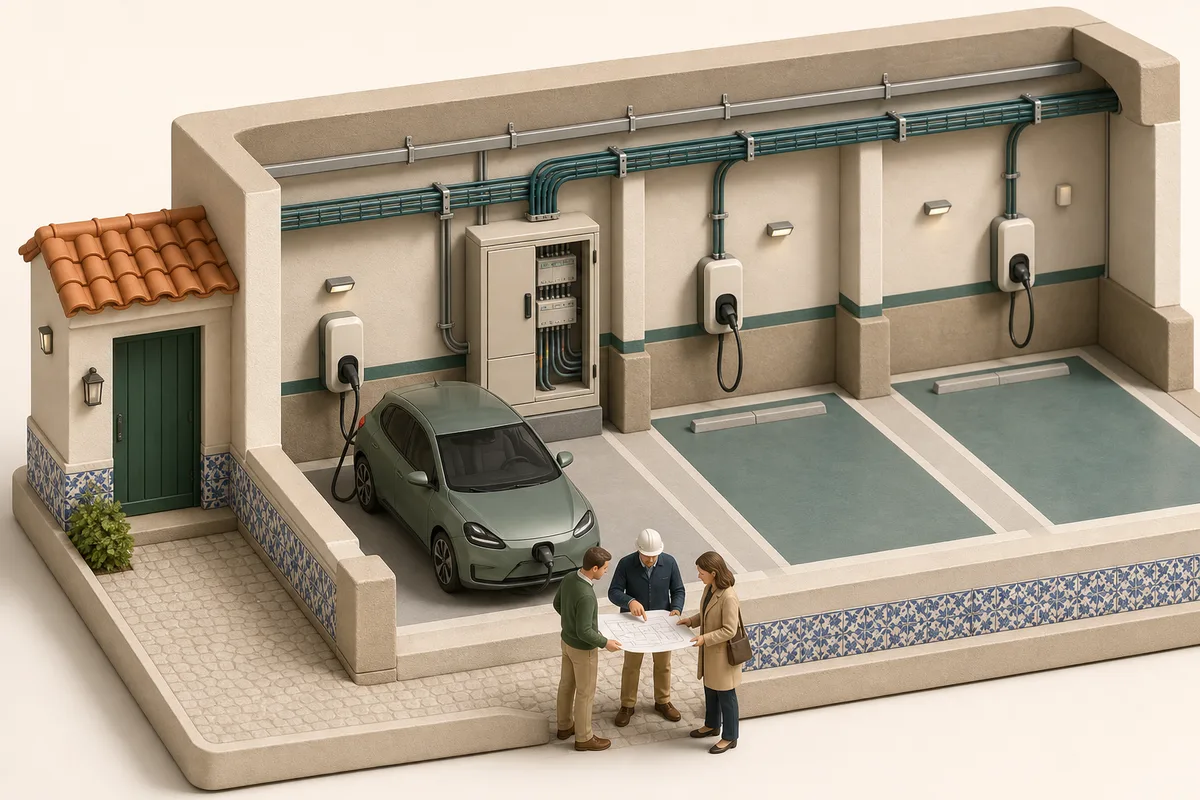
The listing includes a parking space. There is a socket on the wall, perhaps even an installed charger. That does not prove the equipment belongs to the property, that its route through common parts has been regularised, or that enough power is available to charge your car.
Before the CPCV, turn “you can charge here” into a verifiable chain: parking right, route, supply, metering, capacity, responsible party and documents.
Key takeaways
- The right over a parking space and the right to route cables through common parts are separate checks.
- In an existing building, a route through common parts requires at least 30 days' written notice. The statutory grounds for opposition are limited, but the process does not replace design, safety, accessibility or technical evidence.
- A charger may be supplied by the unit, collective installation or a dedicated connection. Each route changes operation, metering, cost and documentation.
- “EV ready” may mean infrastructure only. Ask for the design, as-built evidence, allocated power and equipment actually included.
Start with the parking space and route, not the charger
Identify the parking right legally. Compare the land-registry certificate, horizontal-property deed, plan, tax record and condominium rules. Establish whether the space is part of the unit, a separate unit, a common part allocated for exclusive use, or only subject to a use right. A painted bay number does not answer that question.
Then draw the physical route from a possible supply to the space: unit board, riser, common-services board, garage, walls, ceilings, fire doors and circulation areas. Ask for photographs and a simple plan. Mark where the charger would sit and who controls access to each board and cableway.
Read the condominium minutes, too. Look for previous requests, common infrastructure, quotations, reasoned refusals, power limits, faults, insurance, suppliers and cost-allocation rules. A neighbour's charger proves that one solution was found for that case; it does not prove your space can use the same route or capacity.
Initial parking-space file
- Title, plan and exact identification of the space
- Rules and minutes concerning EV charging
- Proposed route through private and common parts
- Supply origin and associated CPE
- List of existing chargers and allocated power
- Design, as-built drawings and common-infrastructure diagram
- Relevant quotations, contracts, invoices and fault history
- Contacts for the manager and building technician
Read the 30- and 90-day rules without promising automatic approval
For existing buildings, article 23 of Decree-Law 93/2025 allows a condominium owner to install an exclusive or shared charger at their own expense. Where the installation is made in or passes through a common part, even one allocated for that owner's exclusive use, written notice must be given to the condominium administration and, where applicable, the landlord at least 30 days in advance.
The condominium or landlord may oppose only on the grounds stated in the article:
- they will install within 90 days a shared solution with the same services and technology for all potential users;
- a suitable shared solution already exists;
- the installation presents an effective, technically evidenced risk to people or property;
- it obstructs circulation along common access routes;
- common areas would cease to meet the applicable accessibility rules.
The decision deadline is 30 days. A condominium decision requires a simple majority of the building's total value, must be recorded in the minutes and communicated to absent owners; a negative decision must give reasons. The current DGEG FAQ summarises the process and recommends a DGEG-registered professional to assess an alleged safety risk.
A prospective buyer is not yet the condominium owner. Do not treat a viewing or CPCV as though you can already perform every act reserved to the owner. If the outcome is essential, agree the seller's cooperation, technical access, correct notice and consequences of a negative result before paying an unprotected deposit.
Trace the electricity, metering and bill
Ask the technician to identify one concrete architecture. The charger's advertised power is not enough.
| Supply | What to confirm | Likely responsibility |
|---|---|---|
| From the unit | Route to the garage, unit capacity, protection, metering and effect on household loads. | Private-installation holder, with work by a qualified professional. |
| Garage or common-services board | Collective capacity, load control, consumption separation, participation rules and maintenance. | Condominium as collective-installation holder or a contracted OPC. |
| Dedicated connection or CPE | Grid feasibility, works, meter, contract, technical space, timing and connection cost. | Holder, condominium or OPC, depending on the approved solution. |
DGEG explains that where an exclusive point is supplied from the unit, its holder operates it. Where it is supplied from the garage board, common services or riser, operation falls to the collective-installation holder—normally the condominium—or a contracted operator.
Connecting a private point to the MOBI.E network is optional. It can separate the user's charging from the common electricity bill, but it creates its own configuration and operating relationship. Confirm who is registered as the Charging Point Holder, which CPE is associated, how energy and power are paid, which tariff or service applies and how the contract transfers to the buyer. Do not treat the billing platform as electrical-compliance evidence.
If a charger already exists, ask for its make, model, serial number, invoice, warranty, installer, applicable execution declaration, inspections, maintenance, configuration, user accounts and contracts. Record whether the fixed equipment and accessories are included in the sale and whether any grant still carries an active term or obligation.
Obtain feasibility covering load, route and cost
Use a registered responsible technician or authorised installation entity and verify their DGEG registration. Do not open boards, improvise tests or use a general-purpose socket as a charging “trial”.
The study should start with the car and real use: daily energy, charging window, on-board limit and foreseeable simultaneous users. It should then check:
- supply origin, maximum admissible power and available capacity;
- board, protection, earthing, cableway, route length and route conditions;
- penetrations, mechanical protection, fire safety, circulation and accessibility;
- present collective capacity and growth for more users;
- metering, identification, access control and cost allocation;
- design, execution and inspection required for the chosen solution;
- works, dependencies, timing, cost and limitations of the opinion.
E-REDES identifies three scenarios: a new connection, a power-increase request, or no network-side change. For a connection request it recommends a registered technician and an electrical data sheet describing the whole building, not just the unit. “There is power in the garage” therefore does not establish whether the grid, collective installation and your circuit can support the work.
Dynamic load management can distribute available power and avoid or defer upstream reinforcement, but only where the design, equipment and common supply are compatible. The E-REDES FlexC project requires a single installation supplying the garage and chargers, plus a smart system capable of continuously adjusting their load. It is a solution to be designed, not a phrase that closes a sale.
“EV ready” may include neither socket nor charger
For covered new developments, article 22 requires suitable electrical charging infrastructure and expressly distinguishes that infrastructure from the points or sockets themselves. Portaria 128/2026/1 sets minimums and technical rules, including load control for specified multifamily arrangements. Do not use those requirements to assume that an older building was upgraded or that a new development supplies a wallbox in every space.
Where the listing says “ready”, ask the developer or seller for:
- the term's precise contractual meaning;
- design and as-built drawings for the infrastructure;
- spaces served, planned power and load control;
- boards, cables, ducts, meters, communications and equipment delivered;
- work and payments left to each buyer;
- tests, inspections, warranties, operation and availability date.
Visit the space with the design. An empty duct may be useful, but it is not an installed circuit. A reserved board may have no allocated power. A demonstration charger may not form part of the unit.
Put uncertainty in the CPCV and evidence in the handover
If home charging is a condition of the purchase, do not leave it in an agent's message. With a Portuguese lawyer or solicitor, turn unresolved points into obligations and consequences in the CPCV:
- identification of the space and right being transferred;
- equipment, infrastructure and contracts included or excluded;
- documents the seller must deliver;
- technician access and cooperation with the condominium process;
- minimum feasibility, capacity and metering result;
- maximum budget or allocation of costs;
- pending notices, approvals, inspections and connections;
- deadline and effect on the deposit and purchase if the result is not achieved.
At the final inspection, compare the inventory and report: clear parking space, included wallbox and cable, identified board and protective devices, operation demonstrated by the responsible party, original documents, keys/cards/apps, accounts without debt and transfer steps. Record readings where relevant. A green light on the unit does not replace the file.
Frequently asked questions
Can the condominium prevent a charger installation?
Do I need approval before buying the apartment?
Can I connect the charger to the condominium electricity?
Must a private charger connect to MOBI.E?
Must a new building deliver a charger in every space?
This guide is general information, not an electrical design or legal advice. Confirm the title and CPCV with a Portuguese lawyer or solicitor, and use qualified professionals and entities for the technical solution, inspections, connection and operation applicable to the building.
More guides
July 13, 2026
Horizontal property: check before buying
How to check the apartment fraction, common parts, exclusive use, permillage, plans, condominium records and CPCV clauses before buying.
June 12, 2026
Condominium minutes: what to check before buying an apartment
A practical checklist for reviewing minutes, debts, reserve funds and approved works before buying an apartment in Portugal.