Asbestos when buying in Portugal: identify before works
How to locate, test and cost asbestos, protect the CPCV and require evidence of removal before buying a Portuguese home.
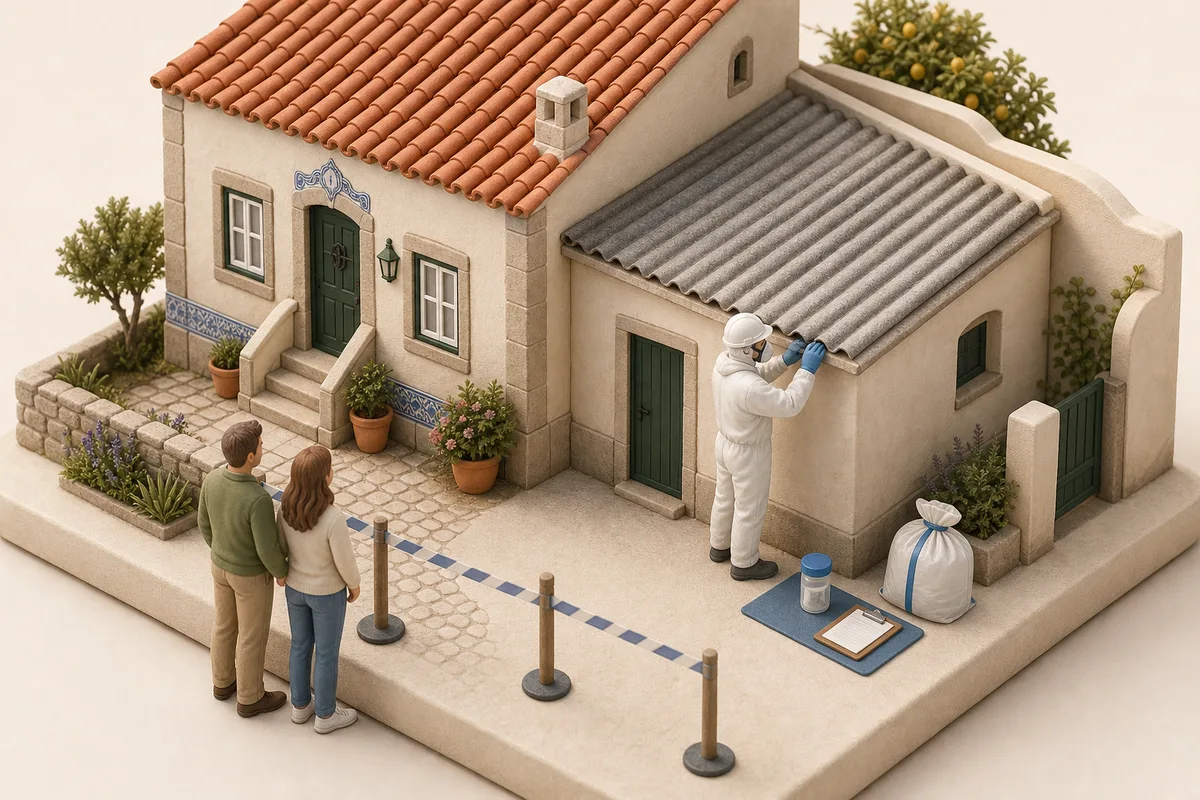
An old corrugated roof may be asbestos cement — or it may not. Colour, shape and a photograph cannot confirm it. Snapping off a corner to “check” turns a documentary uncertainty into an avoidable risk.
When buying in Portugal, separate four decisions: suspect without disturbing, confirm by a suitable method, cost the full intervention, and protect the deal before the CPCV.
Key takeaways
- Intact, non-friable material is generally lower risk; cutting, drilling, sanding or breaking increases fibre release.
- Do not confirm asbestos by appearance or collect a DIY sample. Use a professional and an accredited laboratory for the required test.
- Before the CPCV, turn uncertainty into access, reporting, cost, timing, responsibility and a contractual consequence.
Do not confuse presence, hazard and exposure
Asbestos was used in many twentieth-century building materials. Portugal's Directorate-General of Health (DGS) explains that the danger comes mainly from inhaling fibres released into the air. Every variety is carcinogenic and exposure should be avoided.
That does not make the sight of an intact sheet an emergency. DGS says asbestos in building material generally presents low risk while it remains in good condition, non-friable and undisturbed. Risk rises substantially when it is cut, drilled, fractured, sanded or removed without controls.
Locate suspect material without declaring it by appearance
Start with the building's age, plans, material schedules, work invoices and information from the owner. During a non-destructive inspection, ask the specialist to record location, extent, accessibility, damage and the likelihood that planned work will interfere with it.
DGS and Order 40/2014 identify possible locations including:
- asbestos-cement roof tiles and corrugated sheets;
- cladding, false ceilings, floors and prefabricated elements;
- fire doors and service-shaft doors;
- insulation around pipes, boilers and old equipment;
- waterproofing on roofs and gutters.
This list tells you where to look, not how to diagnose. Later materials can look the same. Less obvious products may sit behind finishes. A general survey, energy certificate and bank valuation are not asbestos registers.
| Evidence | What it supports | What it does not prove |
|---|---|---|
| Age, plans and invoices | Prioritising areas and reconstructing previous works. | The composition of every existing material. |
| Visual inspection | Mapping suspect material, condition and access. | Whether a particular sheet contains asbestos. |
| Accredited analysis | Identifying fibres in the sample and settling that area's question. | Absence from other materials that were not examined. |
Confirm with a sampling plan, not DIY
DGS is clear: confirming asbestos in a material requires laboratory analysis. The consolidated Decree-Law 266/2007, amended in 2026, strengthens identification before covered work and provides for a qualified operator and IPAC-accredited laboratory when analysing susceptible material.
Do not cut a fragment during the viewing or let a contractor do so without a method. Ask a competent asbestos professional whether sampling is needed, who will collect it, how the point will be isolated, how dispersal will be avoided, and which test is suitable. In IPAC's list, check that the laboratory and required test appear in its current accreditation scope.
A useful report identifies the property, location, sample, method, result, laboratory and limitations. A “not detected” result from one sample does not magically clear the entire home: connect each result to the register and planned work.
Settle access, result and consequence before the CPCV
The seller may refuse invasive sampling before an agreement exists. The buyer should not pay a substantial deposit while relying on an inspection right that was never written down. Address the timetable early.
Points to settle before signing
- Which materials and areas will be inspected and, if needed, sampled?
- Who selects and pays the specialist, laboratory and reinstatement of the sample point?
- What access will be provided and by what date?
- Which report is acceptable and how will an inconclusive result be handled?
- Does confirmation lead to removal, encapsulation, a price change or another decision?
- Who bears authorisations, protection, transport, final destination and verification?
- What is the deadline and what happens to the deposit if the condition is not met?
Ask a Portuguese lawyer or solicitor to turn those choices into precise terms. “Subject to inspection” says too little. Define scope, method, evidence, deadline, responsibility and consequence. Do not assume that asbestos automatically cancels the purchase or always forces the seller to remove it.
If you intend to renovate immediately after completion, give the specialist the real project: solar panels, annex demolition, new openings, roof replacement or wall drilling can turn stable material into disturbed material.
Compare the full solution, not only a price per square metre
A serious proposal starts with the register and condition of the material. It should separate what can remain controlled from what will be removed and explain why. For covered work, the provider should explain the applicable ACT notification or authorisation, work plan and protection measures.
APA explains that Order 40/2014 governs removal, packaging, transport and management of the waste. It cannot simply leave with ordinary rubble. APA also provides a search route and list for licensed waste operators.
Compare quotations with the same scope:
- protection of occupants, neighbours, workers and common areas;
- preparation, containment, removal without breakage and cleaning;
- scaffolding, temporary cover and replacement material;
- packaging, transport and receiving operator;
- reinstatement of finishes and waterproofing;
- air sampling or final verification when technically applicable;
- delivered documents, warranty, timing and contingency for extra material.
A cheap quotation that ends when the sheets leave the property gives the buyer the riskiest and least verifiable part of the problem.
Close the intervention with a file that follows the home
If work occurs before completion, do not accept only photographs of a new roof. Connect the diagnosis to the intervention and the waste destination.
Request, as applicable:
- register, laboratory results and condition report;
- work plan and applicable notification or authorisation;
- identification of the parties and invoices;
- before, during and after photographs, without replacing reports;
- transport and acceptance evidence from the authorised operator;
- cleaning, air or reoccupation report where specified;
- warranty, maintenance and a map of material that remains.
At handover, check whether common areas, storage rooms, garages or annexes fell outside the scope. Preserve the file for future work so another contractor does not drill known material because information was lost.
Frequently asked questions
Does every old corrugated roof contain asbestos?
Must all asbestos be removed before a sale?
Can I collect a sample myself?
Does the 0.01 fibres/cm³ limit decide whether I should buy?
Is removal complete when the lorry leaves?
This is general information. Define the survey and intervention with competent specialists and the transaction consequences with a Portuguese lawyer or solicitor.
More guides
August 7, 2026
Damp and water ingress: investigate before the CPCV
How to record signs, diagnose the source, check the condominium and require proof of repair before buying a home in Portugal.
August 5, 2026
Electrical installation when buying: check before the CPCV
How to check the electrical file, condition, power capacity and responsibilities before buying a home in Portugal.