Boreholes, wells and septic tanks: checks before the CPCV
How to check boreholes, wells, pools, septic tanks, public network connection, documents and clauses before buying in Portugal.
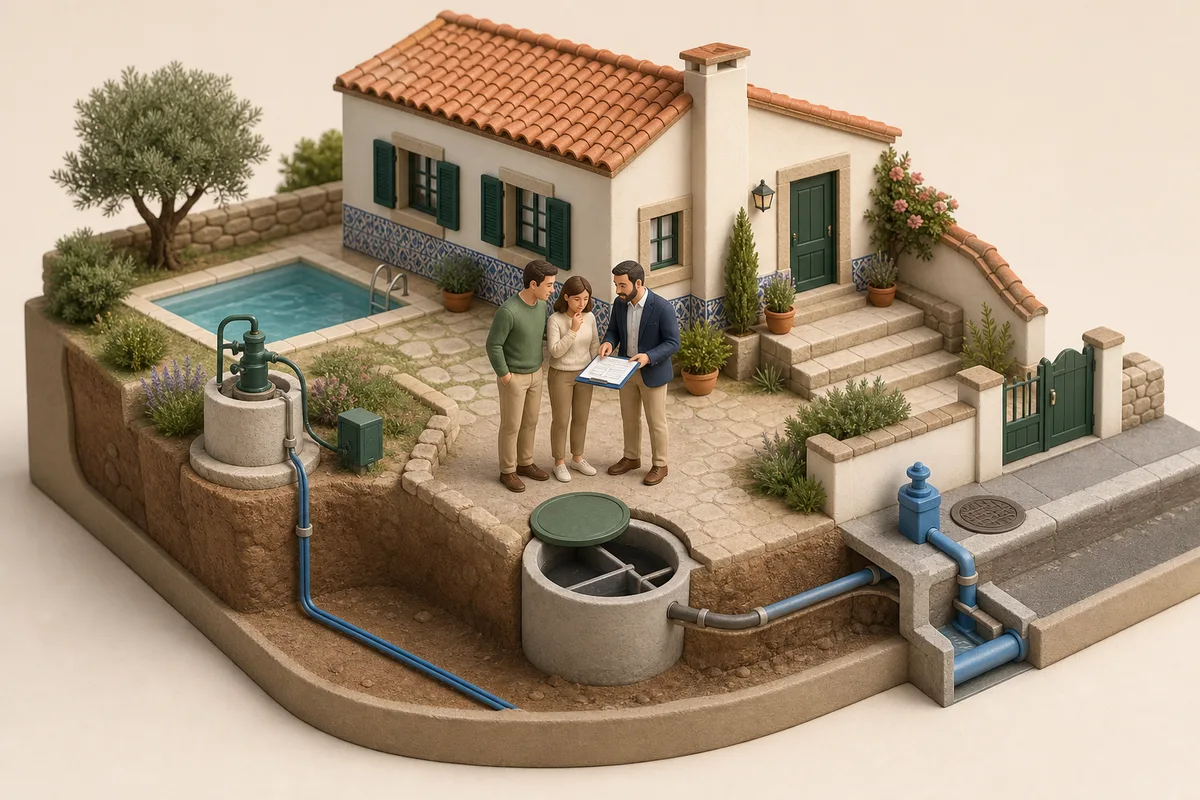
A home with a borehole, well, pool or septic tank can feel more independent. At a viewing, that may sound like an advantage: water for irrigation, a ready pool, less dependence on the network or an old system that has "always worked".
The issue is that this infrastructure sits between planning, environment, sanitation, water quality, maintenance and future cost. Before the CPCV, the buyer should turn vague assurances into documents, tests and clear clauses.
Key takeaways
- Confirm in writing whether public water or sewerage is available and what connection would cost.
- Ask for titles, communications, plans, maintenance proof and tests before signing the CPCV.
- If the home depends on a borehole, well or septic tank, the CPCV should cover documents, regularisation and consequences.
What is really at risk
The main risk is not that a borehole, septic tank or pool exists. It is not knowing whether it exists in a documented, safe way that fits how the home is being used.
A water capture may be suitable only for irrigation, not drinking water. A septic tank may need regular emptying, tanker access and proof of disposal. A pool may have been built without a municipal process. And a nearby public network may create a connection obligation that costs money and changes how the property operates.
For a bank, valuer, insurer or future buyer, infrastructure without evidence can stop being an advantage and become uncertainty.
First: is there a public network nearby?
Before discussing the borehole or septic tank, confirm the public-network position. As a rule, when public water supply or wastewater sewerage is available within 20 metres of the property boundary, the owner must connect the property to that network.
This changes the purchase analysis. A house with a septic tank may work today but come with a connection cost tomorrow. A borehole used for drinking water may need to stop being used for that purpose when public supply is available, possibly remaining only for uses such as irrigation if allowed.
Questions for the utility provider
- is public water or sewerage available near the property?
- does the distance to the property boundary trigger a connection obligation?
- what is the estimated cost of branch, connection, meter, fees and internal works?
- are there debts, old contracts, disconnections or pending requests for the property?
- if there is no network, how is septic tank emptying arranged?
Keep the answer in writing. Do not leave this check until after completion, because by then the cost is yours.
Boreholes, wells and mines: existence is not the same as right to use
An old borehole or well can physically exist and still raise questions. Who had it built? Is there a title, communication or licence? What use was declared? Is there a technical report? Are the pump, pipes and electrical board safe? Has the water been analysed recently?
| Situation | What to ask for |
|---|---|
| Borehole or well used for irrigation | Applicable title, communication or proof, plan location, characteristics, maintenance and expected use. |
| Water used inside the home | Recent analysis, treatment system, authorised purpose and confirmation that no mandatory public network applies. |
| Capture with no documents | Regularisation before completion or a clause allowing you to withdraw or renegotiate if it cannot be regularised. |
If the capture is essential to the property's value, treat it as part of the deal. The seller should provide documentation and allow a technical check before the CPCV, or at least before the deposit is at risk.
Septic tank: check capacity, access and emptying
The septic tank is often the item the buyer only discovers when there is smell, blocking or an emptying request. Before that, confirm whether the home is truly outside public sewerage coverage, whether the tank is located on the plot, whether a tanker can access it and whether maintenance proof exists.
Septic tank checklist
- location on a plan or clear identification on site;
- system type, capacity and number of users it was designed for;
- tanker access without relying on neighbours;
- proof of previous emptying and responsible entity;
- no discharge to water lines, ditches or neighbouring land;
- utility-provider confirmation on future connection to public sewerage.
If there is technical doubt, request an inspection. A badly sized or badly located tank can be expensive, unpleasant and hard to fix after purchase.
Pool: check planning, water and maintenance
A pool is more than leisure equipment. It may affect impermeable area, footprint, setbacks, constraints and the municipal file. If it was built after the house, ask for the communication prior, licence or other applicable municipal framework.
Also confirm the water source and maintenance. Filling a pool from a borehole, public supply or tanker has different costs and rules. The buyer should know whether there are leaks, filtration problems, broken equipment or pending works.
Pool checklist
- proof of the municipal process or technical confirmation that it is regular;
- footprint on plan and match with the reality on site;
- water source used for filling and top-up;
- state of pump, filter, lining, electrical board and safety;
- annual costs for maintenance, energy, products and foreseeable repairs;
- impact on insurance, municipal tax, valuation and future resale.
A beautiful pool at the viewing can hide a discount if proof of regularity is missing or the equipment is near end of life.
How to protect yourself in the CPCV
If the home depends on this infrastructure, do not sign a generic CPCV. List what exists, what it is used for, what documents will be delivered and what happens if something is not confirmed.
Practical clauses to discuss
- delivery of titles, communications, plans, analyses and proof before completion;
- seller statement on current use of borehole, well, pool and septic tank;
- suspensive condition if essential infrastructure cannot be regularised;
- responsibility for public-network connection costs already due;
- right to technical inspection before the deposit deadline is locked;
- retention or price adjustment if regularisation or repair is pending.
The point is not to turn the buyer into an engineer. It is to stop an expensive part of the home being reduced to a verbal sentence.
FAQ
Can a home with a borehole use that water for drinking?
If public sewerage is nearby, can I keep the septic tank?
Does a pool always need documents?
Next step
Before the CPCV, make one page with four answers: public network, borehole/well documentation, septic tank condition and pool regularity. If one answer is "I don't know", you do not yet have enough information to treat it as a property advantage.
More guides
August 7, 2026
Damp and water ingress: investigate before the CPCV
How to record signs, diagnose the source, check the condominium and require proof of repair before buying a home in Portugal.
August 5, 2026
Electrical installation when buying: check before the CPCV
How to check the electrical file, condition, power capacity and responsibilities before buying a home in Portugal.