Hidden defects when buying in Portugal: protect yourself before the CPCV
How to reduce the risk of damp, leaks, cracks, faults, hidden works and defects discovered only after completion.
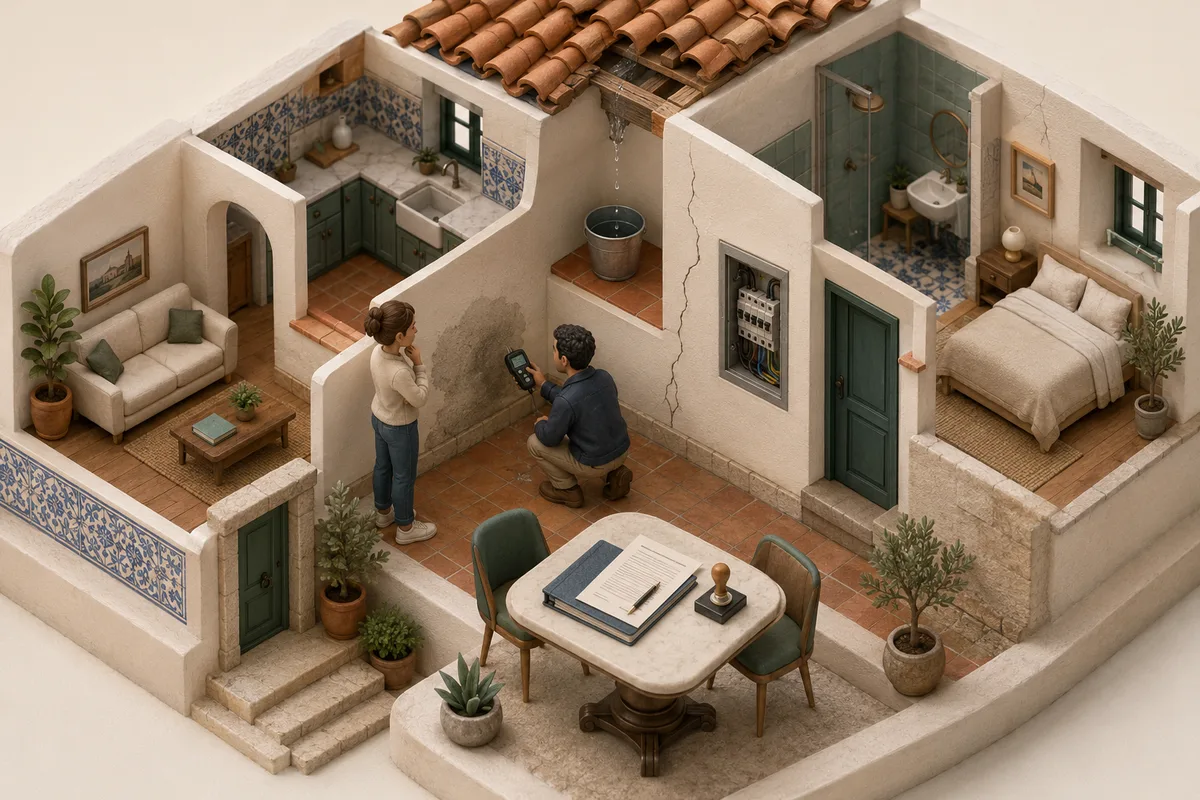
A hidden defect rarely appears as a "hidden defect" at the viewing. It appears as a recently painted wall, a small-looking crack, an unexplained smell, an enclosed balcony that has "always been like that" or an electrical system that only fails after you move in.
After completion, arguing about defects is harder: you need evidence, timing, reports and often a lawyer. Before the CPCV, you can still turn doubt into an inspection, documents, written questions and clauses.
Key takeaways
- A visual viewing is not a technical inspection, especially for used or renovated homes.
- The legal position can change a lot depending on whether the seller is private or professional.
- If you discover a defect after purchase, document it before repairing and speak to a lawyer quickly.
The risk is not only the repair
The visible cost is the works: fixing damp, opening a wall, replacing pipes, correcting electrical faults or treating humidity. But the bigger risk may be proof.
After completion, the seller may say the defect did not exist before, was visible, comes from poor maintenance, was caused by the buyer's works or was never promised as part of the sale.
So do not treat hidden defects as only a legal topic. Treat them as due diligence: identify signs, keep answers and decide what must be conditional before paying a deposit.
Check whether the seller is private or professional
Not every purchase has the same protection. In a sale between private parties, the discussion often sits under the Civil Code rules on defective sale: defects that devalue the property, prevent its intended use or contradict qualities assured by the seller.
When the seller is a professional and the buyer is a consumer, such as a developer, builder, renovation company or professional seller, the property conformity regime may apply. That regime is more structured and can have different periods for structural elements and other problems.
| Situation | Practical reading |
|---|---|
| Private seller | Do not assume a simple warranty. Evidence of the defect, knowledge and deadlines becomes central. |
| Developer, builder or professional seller | Ask about conformity rules, guarantees, reports, technical files and repair responsibility. |
| Used home renovated for resale | Check whether the seller acts professionally and ask for invoices, permits, liability statements and works guarantees. |
This difference should be considered before negotiating the CPCV, not only when a problem appears.
What to check before the CPCV
Start with technical signs and document signs. A home can have a use licence and an energy certificate and still have a leaking roof, old electrical system or interior works with no evidence.
Signs to take seriously at the viewing
- walls recently painted in only one area;
- smell of damp, mould, sewage or combustion;
- cracks near windows, ceilings, balconies, pillars or annexes;
- false ceilings or panels hiding pipes and leaks;
- old electrical board, sockets without earth or improvised breakers;
- windows with condensation, loose frames or water-entry marks;
- annexes, attic space, garage converted into a room or enclosed balcony;
- recent works with no invoices, plans, permits or communications.
If the home is old, renovated or shows risk signs, ask for an inspection by an independent engineer, architect or technician. The visit should happen before the deposit is at risk, or the CPCV should make the purchase dependent on the result.
Ask questions in writing
Verbal questions disappear. Email or message questions can be kept in the file and turn a vague assurance into a useful statement.
Questions for the seller or agent
- are there known leaks, damp, pipe issues, blockages or electrical faults?
- have there been insurance claims, condominium complaints, roof, facade, riser or terrace works?
- what works were done in recent years and who carried them out?
- are there invoices, guarantees, projects, liability statements or municipal processes?
- does any advertised area come from an enclosed balcony, attic, annex or converted garage?
- do the included systems and appliances work and remain in the condition viewed?
The estate agent does not replace a technical inspector or your lawyer, but the property information should be presented clearly and not misleadingly. If a feature matters to your buying decision, ask about it in writing.
How to protect yourself in the CPCV
A generic CPCV pushes the risk to later. If there are technical doubts or recent works, the contract should say what has been declared, what remains to be delivered and what happens if verification fails.
Practical clauses to discuss
- right to a technical inspection before a clear date;
- suspensive condition if the inspection finds a serious defect or cost above a defined limit;
- list of systems, appliances and works included in the sale and their declared condition;
- seller statement on absence of known leaks, damp, faults or disputes;
- delivery of invoices, guarantees, reports, plans and works documents before completion;
- retention, prior repair or price adjustment when a problem is identified;
- express consequence for missing documents or false declarations.
Be careful with accepting "sold as seen" without reservations if you have not done the relevant checks. That wording can be normal for used homes, but it should not replace essential questions or documents.
If you discover a defect after purchase
Do not start by repairing everything without evidence, unless there is a real emergency. Take photos, record videos, keep messages, call an independent technician and ask for a report covering likely cause, apparent age and risk.
Then speak to a lawyer quickly. With property defects, deadlines and the way you communicate the problem can be decisive. The route also changes if the seller was private, professional, builder or developer.
FAQ
Does a used home always have a warranty?
Can I rely on the deed and mandatory documents?
Should every home have an inspection?
Next step
Before the CPCV, make a short list: risk signs, written questions, missing documents and decisions that depend on inspection. If an important answer is still "I don't know", do not treat that uncertainty as a detail.
More guides
August 7, 2026
Damp and water ingress: investigate before the CPCV
How to record signs, diagnose the source, check the condominium and require proof of repair before buying a home in Portugal.
August 5, 2026
Electrical installation when buying: check before the CPCV
How to check the electrical file, condition, power capacity and responsibilities before buying a home in Portugal.