Buying off-plan in Portugal: protect payments and deadlines
How to check the promoter, urbanistic title, plans, specifications, staged payments, mortgage timing, delays, defects and CPCV clauses.
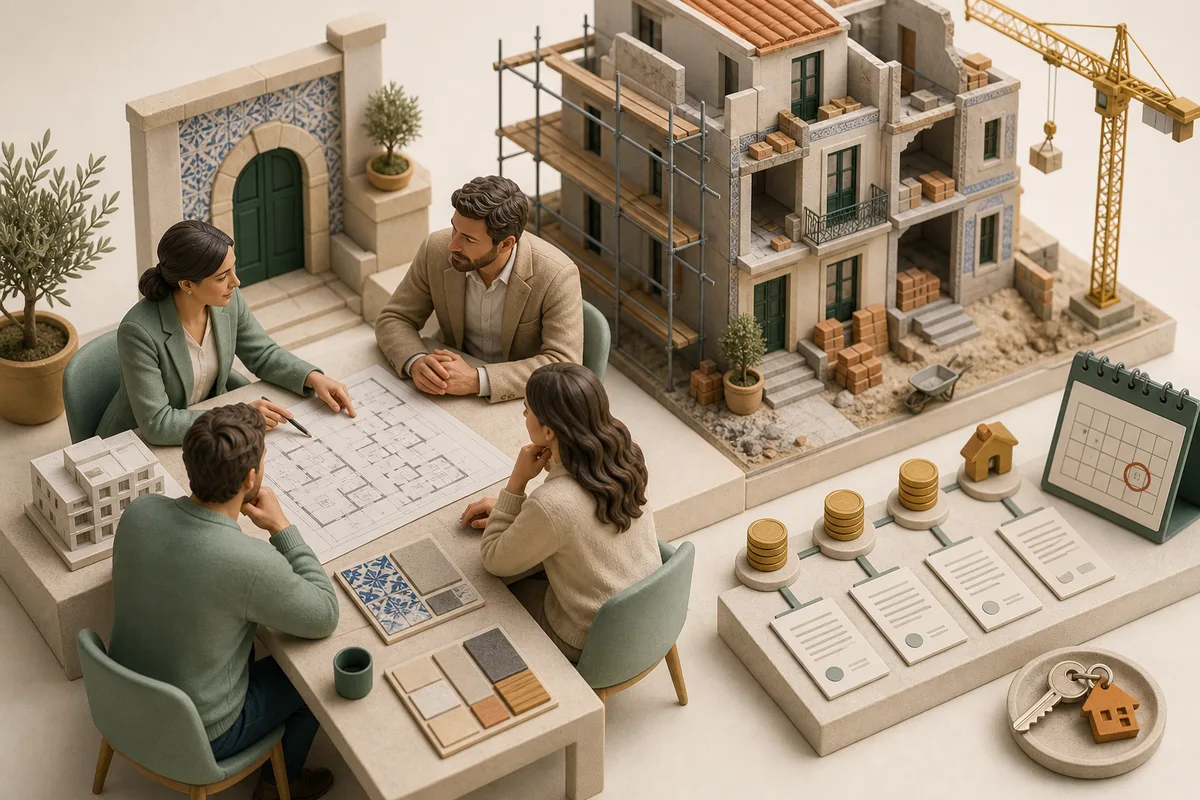
Buying off-plan can feel simple: choose the unit, pay a reservation, sign the CPCV and wait for construction. The risk is that, when you pay the deposit, the home may still be a set of plans, renders, promises and dates.
Before the CPCV, turn the promise into documents: who is selling, what urbanistic title exists, which plan and finishes are attached, when each tranche is paid, how the money is protected and when the bank will make its final credit decision.
Key takeaways
- Renders are not enough: attach plans, areas, finishes, parking, storage and substitution rules to the CPCV.
- Staged payments should be linked to verifiable construction milestones, not vague dates.
- A mortgage pre-approval today does not guarantee final approval when the home is complete.
Start with who sells and who builds
In an off-plan purchase, the risk is not only the home. It is also the promoter, the contractor, the estate agent, the land, the construction financing and the person who has authority to sign.
Before paying a meaningful reservation, check the company's legal name, tax number, who signs, whether the agent has an AMI licence when there is mediation, and whether the contractor has the right IMPIC authorisation for private works. If the answer is only verbal, ask for documents.
Initial checks
- full identification of the promoter and signing representative;
- commercial certificate or equivalent company proof;
- the promoter's link to the land or development;
- AMI licence for the estate agent, if there is real-estate mediation;
- IMPIC licence or certificate for the contractor;
- track record of previous developments, delays, complaints and handovers.
The plan must become a CPCV annex
The buyer is not buying "a nice two-bed on the third floor". The buyer is buying a specific unit with area, floor, orientation, balcony, parking, storage, materials, equipment, common areas and change rules.
Ask for the urbanistic title or evidence of the applicable authorisation route, approved plans, specifications, area schedule, fractions, parking and storage. Portugal's Simplex Urbanistico changed some sale formalities, but that does not make these documents irrelevant for due diligence.
| Document | Why it matters |
|---|---|
| Urbanistic title or municipal file | Helps confirm that the works follow a verifiable legal route and are not only a sales promise. |
| Plans and areas | Defines unit, floor, layout, balcony, parking, storage and relevant delivery differences. |
| Specifications | Prevents brands, materials and equipment from being replaced without a clear quality standard. |
| Condominium and common areas | Shows lifts, garages, gardens, facades, roofs, expected charges and handover responsibilities. |
If the promoter says "the final document is not ready yet", ask what exists now, what is missing, when it will be ready and what happens if it is not issued.
Do not pay tranches without verifiable milestones
The biggest financial risk is paying too much before completion. Developments may involve reservation, CPCV deposit and staged payments. The issue is not only the amount: it is whether the money is protected and what proof triggers each payment.
Before each payment
- confirm who receives the money and which account is used;
- require a receipt and contract reference;
- link the tranche to an objective milestone: structure, roof, facades, licence, inspection or another verifiable event;
- ask for milestone proof before paying;
- ask whether there is a bank guarantee, seguro-caucao, escrow or client account;
- confirm whether the protection covers the full amount, who benefits and when it can be called.
Do not assume that a bank guarantee or seguro-caucao is mandatory in every off-plan purchase. Treat it as protection to negotiate and validate with a lawyer.
Mortgage: the final decision comes later
A pre-approval before the CPCV does not guarantee that the bank will approve the mortgage when construction is complete. Income, rates, bank policy, valuation, LTV and property documents can all change.
Ask the bank how it treats off-plan purchases, whether it finances the deposit or only completion, when it values the property, which documents it needs and what happens if the bank valuation comes below the price.
Delays, handover and defects
"Expected in Q4" is different from a long-stop date with a grace period and consequences. Construction delays can happen, but the CPCV should say how much delay is acceptable and what happens after that.
Before completion, try to inspect the unit. Compare the home with plans, finishes, equipment, windows, HVAC, panels, garage, storage, meters, lifts, gates, roof, drainage, common areas and condominium documents.
At handover
- bring the plans, materials and equipment list attached to the CPCV;
- photograph defects, damage, missing items and substitutions;
- confirm manuals, warranties, technical sheets, keys, remotes and meters;
- ask about expected charges, reserve fund and initial administration;
- report defects in writing and keep evidence.
For homes sold by professional sellers, legal guarantee periods apply, including specific periods for structural construction elements. Still, having rights does not mean instant repair. Document early and get help if the response is slow.
What to discuss in the CPCV
An off-plan CPCV should be more detailed than a CPCV for a finished home. Use these points as an agenda for your lawyer or solicitor, not as a template.
Points to negotiate
- annexes with plans, areas, specifications, parking and storage;
- promoter identification, signing powers and urbanistic documents;
- staged payments with objective milestones and proof before each tranche;
- guarantee, seguro-caucao, escrow or other protection where possible;
- completion deadline, grace period, compensation and termination right;
- limits on substitutions of materials and equipment;
- financing condition adjusted to final approval timing;
- inspection before completion and treatment of listed defects.
FAQ
Is buying off-plan riskier than buying a finished home?
Is a bank guarantee always mandatory?
Can I rely on mortgage pre-approval?
Next step
Before signing, ask for one simple file: promoter and signing powers, urbanistic title, plans, specifications, payment calendar, deposit protection, financing condition and inspection rule. If one of these points is essential to the purchase, do not leave it until after the CPCV.
More guides
August 7, 2026
Damp and water ingress: investigate before the CPCV
How to record signs, diagnose the source, check the condominium and require proof of repair before buying a home in Portugal.
August 5, 2026
Electrical installation when buying: check before the CPCV
How to check the electrical file, condition, power capacity and responsibilities before buying a home in Portugal.