Buying a home with solar panels: what to check
How to check DGEG, CPE, ownership, warranties, bills, condominium approval and CPCV clauses before buying with solar panels.
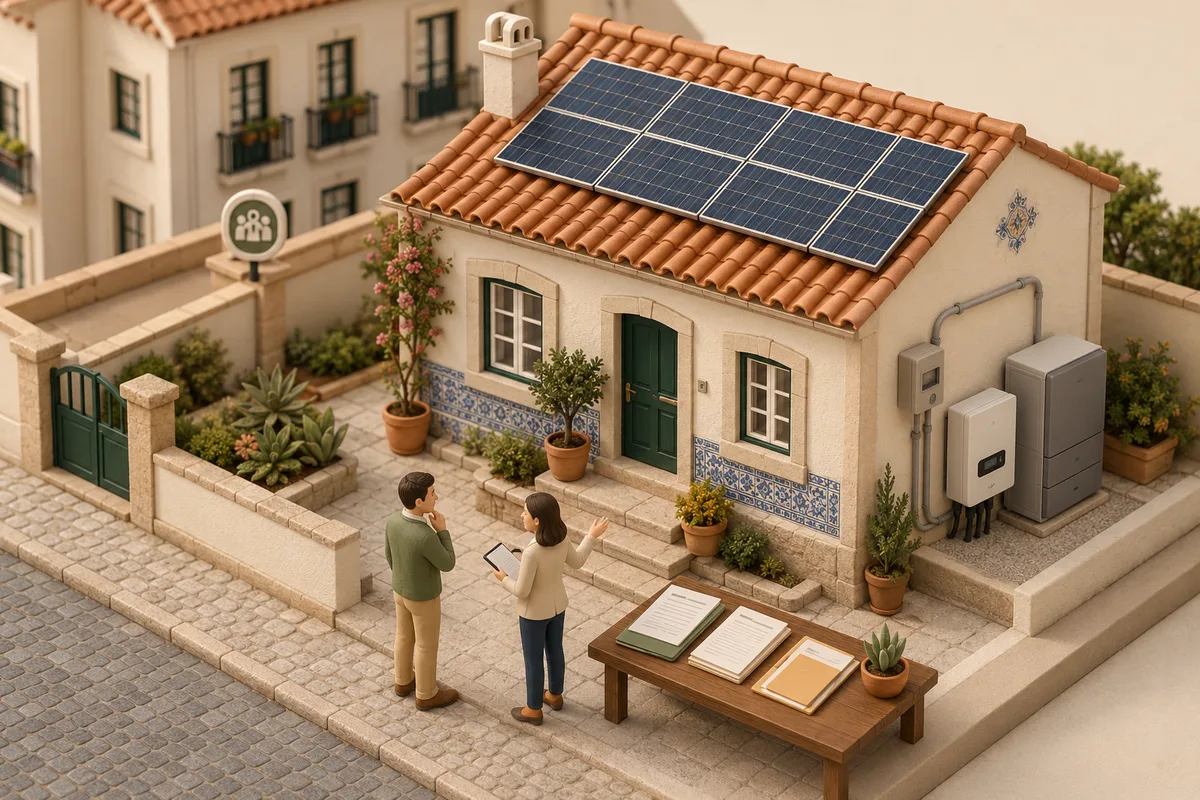
A home with solar panels can look more efficient, more modern and cheaper to run. But before the CPCV, the right question is not only "does it have panels?". It is: "who owns the system, is it registered, will it transfer to me, and does it work as advertised?".
The buyer may be inheriting a UPAC, inverter, batteries, warranties, surplus sale contracts, app accounts, roof works and, in an apartment, condominium permissions. All of that should be clear before paying the deposit.
Key takeaways
- Check DGEG, CPE, ownership, bills, warranties and contracts before the CPCV.
- In an apartment, the roof may be a common part and require minutes, internal rules or a collective self-consumption agreement.
- If the panels affect the price, put transfer and document delivery obligations in the CPCV.
Solar panels are not automatic value
A well-documented system can reduce grid consumption, improve comfort and help explain a better energy rating. But it may also be old, badly sized, shaded, poorly matched to the household's daytime use, or dependent on an app and contracts still in the seller's name.
Ask for real data: electricity bills, inverter production history, installed power, orientation, equipment age, maintenance and warranties. Without that, "has solar" is only a listing phrase.
Documents to request before the CPCV
For self-consumption, DGEG uses specific procedures for UPAC registration and changes. Some smaller systems use prior communication; others involve registration, certificates, fees or extra steps. Do not guess from the number of panels on the roof.
Solar document pack to request
- DGEG registration, prior communication proof or UPAC registration number;
- associated CPE, current holder and installed power;
- purchase invoices, installer details, panel, inverter and battery models;
- warranties for panels, inverter, batteries, mounting, workmanship and waterproofing;
- production history from the app or inverter, ideally 12 to 24 months;
- electricity bills before and after installation, if available;
- surplus-sale, aggregator, finance, lease or maintenance contracts;
- energy certificate and whether the system was considered in the assessment.
If a document does not exist, ask why in writing. It may be harmless, but it can also show that the system is not regularised, does not belong to the seller or will not transfer as expected.
Transfer does not happen only through the deed
The deed transfers ownership of the property. It does not, by itself, guarantee that the UPAC, app account, electricity contract, inverter warranty or surplus sale arrangement automatically pass to the buyer.
| Topic | What to confirm |
|---|---|
| DGEG holder | Who the current holder is and which steps are needed to change the holder after purchase. |
| CPE and meter | Whether the UPAC is linked to the correct CPE and whether changing the injection point could require a new registration. |
| Equipment | Whether panels, inverter, batteries, mounting and monitoring are included and free from burdens. |
| Contracts | Whether there is surplus sale, an aggregator, lease, finance, maintenance or third-party right. |
Agree with the seller who handles each step and by when. If the system is an important part of the price, do not leave this to informal emails after completion.
In an apartment, look at the roof first
In apartment buildings, panels may be on a common part. They may serve one unit, the condominium, some owners or a collective self-consumption scheme. That changes the question completely.
Ask for condominium minutes, permission to use the roof, internal rules, EGAC details where collective self-consumption exists, sharing coefficients, insurance, maintenance responsibility and rules when a unit is sold.
Also confirm who pays if panels must be removed for roof repairs, leak fixes or common works.
Get a technical inspection if the value is material
Not every risk appears in the paperwork. An electrician, solar technician, engineer or architect can check points a buyer usually cannot evaluate.
Inspection points
- condition of panels, fixings, cables, electrical protections and board;
- age, ventilation and location of inverter and batteries;
- shading, orientation, dirt and expected production;
- roof penetrations, waterproofing and signs of leaks;
- compatibility with meter, CPE, electricity contract and monitoring;
- near-term costs: inverter, battery or roof replacement/repair.
If the inspection shows the system is worth less than advertised, you can renegotiate price, request repairs, require documents or walk away before the deposit is at risk.
How to protect yourself in the CPCV
When the panels matter to the decision, the CPCV should treat the system as part of the purchase, not as decoration.
Practical clauses to discuss
- express list of included equipment: panels, inverter, batteries, mounting, meter, cables and monitoring;
- seller statement that the equipment is seller-owned and not leased, financed, pledged, retained by title or subject to an undisclosed third-party contract;
- delivery of DGEG proof, CPE, invoices, warranties, manuals, contracts and production history;
- seller cooperation to change holder, contracts, apps and warranties;
- condition if the system is not regularised, does not transfer or depends on missing condominium approval;
- technical inspection and remedy for defects, leaks, broken equipment or missing documents.
Do not use these ideas as drafting. Use them as topics for your lawyer or solicitor to adapt to the specific case.
FAQ
Is a home with solar panels always worth more?
Does the UPAC transfer automatically at completion?
Does the energy certificate prove I will save on bills?
Next step
Before signing the CPCV, request the solar document pack, confirm holder/CPE and book a technical check if the system affects the price. If an answer is essential, turn it into a written condition.
More guides
August 7, 2026
Damp and water ingress: investigate before the CPCV
How to record signs, diagnose the source, check the condominium and require proof of repair before buying a home in Portugal.
August 5, 2026
Electrical installation when buying: check before the CPCV
How to check the electrical file, condition, power capacity and responsibilities before buying a home in Portugal.