Land boundaries: check before the CPCV
How to check area, walls, tax record, land register, BUPi, cadastre, access and survey before buying a home with land.
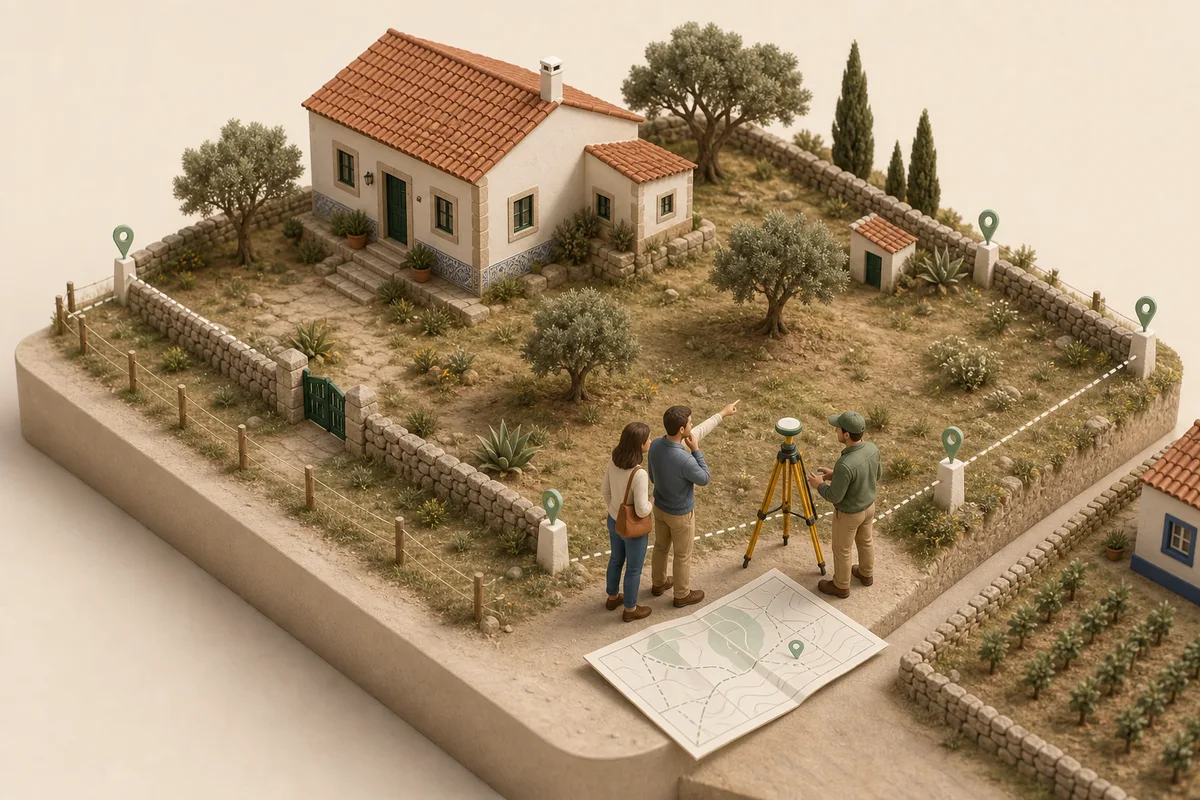
Buying a detached home, quinta or plot with a house in Portugal is not only buying the building. You are also buying boundaries: where the property starts, where it ends, which area is included and whether that area is the same in the land register, tax record, BUPi, cadastre and the land you visited.
The problem is that walls, fences, olive trees, old tracks and listing maps can tell a different story from the documents. Before the CPCV, check whether you are buying the right land.
Key takeaways
- Do not assume the fence proves the legal boundary.
- Compare land register, tax record, RGG/BUPi, cadastre, plans and physical reality.
- If area, boundaries or access drive the price, bring them into the CPCV.
The risk: buying area you cannot confirm
The listing may say "house with 2,000 m²", but the real purchase depends on what is documented and registrable. If the advertised area includes a track used by neighbours, a strip occupied for years, an annex outside the boundary, another tax article or land that was never registered, the discount can disappear.
This affects more than pride in the garden. It can change value, bank valuation, your ability to fence the land, build a pool, extend the house, resell later or solve disputes with neighbouring owners.
Start by comparing land register and tax record
Ask early for the permanent land-register certificate and the tax record (caderneta predial). The register identifies the property description, owners, charges and identifying elements. The tax record is fiscal: tax article, fiscal holder, use, areas and tax value.
Neither document, by itself, replaces a boundary check. The point is to compare: parish, article, description, rustic, urban or mixed nature, total area, covered area, uncovered area, neighbouring boundaries, annexes, yard and outbuildings.
| Signal | What it may mean | What to ask for |
|---|---|---|
| Advertised area far above the tax record | The listing may include neighbouring land, informal area or unsupported measurement. | Written explanation, register, tax record, RGG/cadastre and topographic survey. |
| Register and tax record show different areas | May require harmonisation, rectification or review of legal tolerance rules. | Solicitor, registry or lawyer review before risking the deposit. |
| Home sold with several tax articles | There may be separate properties, different owners, access issues or separate taxes. | Full list of articles, descriptions, owners and what enters the deed. |
If there are easements, shared tracks or access over someone else's land, check how that access is documented. A path used for years is not the same as a clear, bankable easement.
BUPi, RGG and cadastre: useful, but read the status
For rustic and mixed properties, BUPi is central to identifying and georeferencing land. In 2026, georeferenced graphical representation became even more important in transfer acts for rustic and mixed properties.
For the buyer, this should not be seen as seller bureaucracy. It is a way to check whether the parties know which land is changing hands.
Check in BUPi or cadastre
- whether the municipality has joined and whether an RGG exists for the property;
- whether the RGG is validated, pending or has a geometry reservation;
- whether the property is already in the cadastral map/SNIC;
- whether the RGG area matches the register, tax record and visit;
- whether there is overlap, conflict or uncertainty with neighbouring plots;
- whether the deed needs an RGG number or equivalent proof.
Do not treat a map screenshot as a final solution. An app delimitation, KML file or drawing over aerial imagery can help the discussion, but it does not replace the applicable validation, registration and professional review when serious money is at risk.
On site, look for physical inconsistencies
Take the documents to the land. Walk the perimeter if possible. Check boundary markers, walls, fences, ditches, water lines, tracks, gates, annexes, wells, tanks, reference trees and utility connections.
Ask the seller and neighbouring owners, but do not turn conversations into sufficient proof. If one edge is "more or less over there", if everyone uses the track, or if a neighbour disputes the fence, you need more diligence.
Signals to hire a surveyor
- the price depends heavily on exterior land area;
- rustic or mixed property with unclear visible boundaries;
- area mismatch between listing, register, tax record and BUPi;
- recent walls or fences;
- absent neighbouring owners, inheritances or abandoned land;
- plans to fence, build, extend, plant or finance with a bank.
An independent topographic survey can feel like an extra cost, but it is small compared with buying too little land or inheriting a boundary dispute.
How to protect yourself in the CPCV
If the boundaries are clear, the CPCV should list every property, tax article, description, area, outbuilding and access included. If doubts remain, do not leave them in loose messages.
Include conditions for delivery or validation of the RGG, area harmonisation, satisfactory topographic survey, absence of overlaps, access confirmation and final mortgage approval, when you depend on a bank.
It may also make sense to retain part of the deposit, reduce the initial deposit or delay the CPCV until there is enough proof. The more the purchase decision depends on the land, the less you should accept "we will solve that after the deed".
FAQ
Does the tax record prove the land boundaries?
Can I rely on existing walls and fences?
Does BUPi solve every boundary problem?
Next step
Before signing, make a five-column table: listing, land register, tax record, BUPi/cadastre and site visit. If one column describes a different area, boundary or access, make that difference a CPCV condition or solve it before paying a large deposit.
More guides
August 7, 2026
Damp and water ingress: investigate before the CPCV
How to record signs, diagnose the source, check the condominium and require proof of repair before buying a home in Portugal.
August 6, 2026
EV charging in a condominium: check before buying
How to verify the space, route, capacity, metering, condominium process and costs before relying on EV charging when buying.