Young-buyer IMT relief: check before your first home
How to check age, first-home status, shares, limits, CPCV, stamp duty and cash planning before relying on the relief.
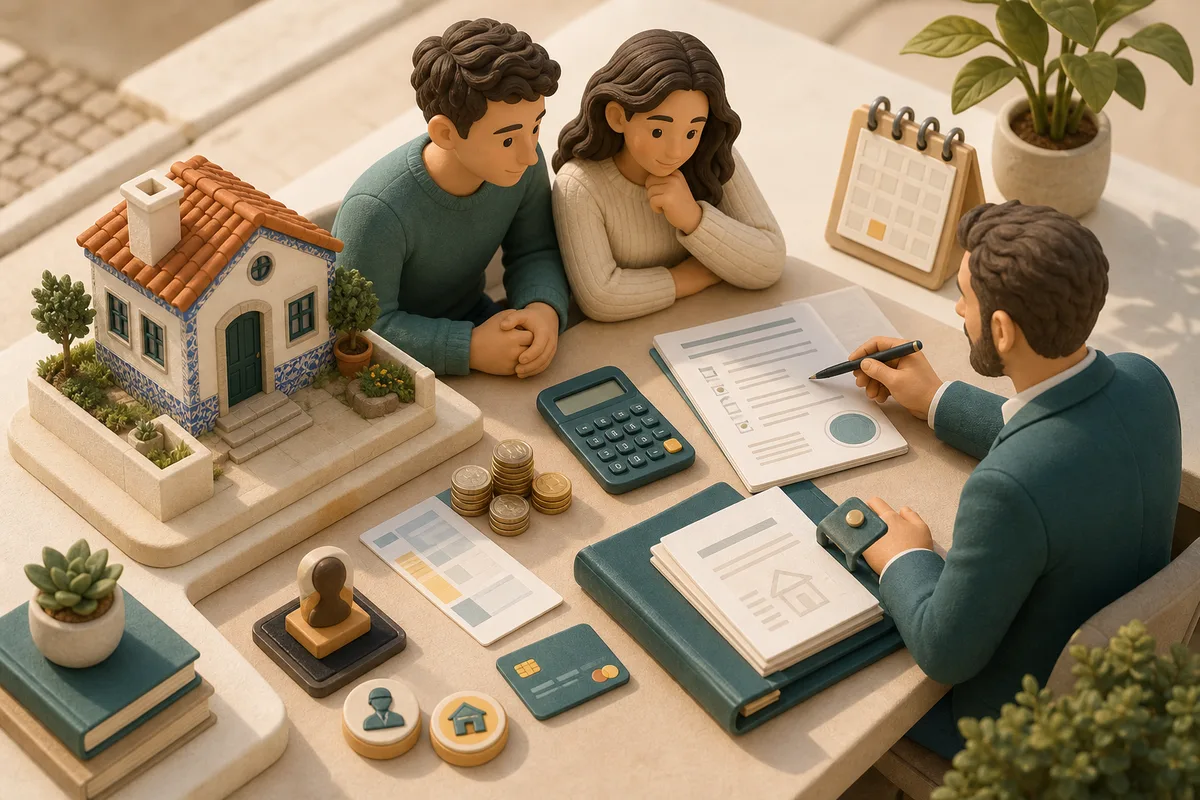
Portugal's young-buyer IMT relief can change the cash needed for a first home. For some buyers, the difference between paying IMT and stamp duty or benefiting from relief is the difference between completing comfortably and being short of cash.
But do not treat the relief as guaranteed money on the day you sign the CPCV. Age, property use, own permanent home status, previous ownership and deed timing can all change the answer.
Key takeaways
- Eligibility should be correct on the acquisition/completion date, not only when you make the offer.
- In 2026, for mainland Portugal, the AT practical table shows IMT relief up to EUR 330,539 and partial relief up to EUR 660,982.
- If you buy with someone else, each buyer should confirm their own eligibility and ownership share.
Start with eligibility, not the saving
Before relying on the relief, confirm whether the purchase fits the purpose of the regime: a young buyer's first purchase for their own permanent home. In practice, review age, tax dependency, intended use and previous ownership.
Questions before the CPCV
- will you be aged 35 or under on the expected completion date?
- are you buying for your own permanent home, not investment, holiday use or short-term rental?
- have you owned or co-owned another residential property in the relevant previous years?
- are you still treated as a dependent for Portuguese tax purposes?
- do all buyers qualify, or only one buyer's share?
- can completion happen before any buyer loses eligibility by age?
If any answer is uncertain, do not rely on a quick simulator. Ask your solicitor, lawyer, notary or AT before the CPCV puts your deposit at risk.
Understand the price limits
The relief does not make every price the same. The purchase price matters. In 2026, for mainland Portugal, the Portuguese Tax Authority's practical young-buyer IMT table shows a zero IMT rate up to EUR 330,539 and a next band up to EUR 660,982 with partial relief.
If the price is above the full-relief band, some tax may be payable. If it is above the benefit limit, the relief may no longer help. Do not assume "I am young" means "I pay nothing".
| Situation | Practical reading |
|---|---|
| Price within the full-relief band | The saving can be large, but personal eligibility still has to be correct. |
| Price in the partial band | Some tax may still be due. Simulate with and without the benefit before agreeing the deposit. |
| Price above the benefit limit | Prepare for normal tax unless your adviser confirms otherwise. |
If you buy together, check the shares
Many buyers discover late that eligibility is not a label on the property: it is a condition for each buyer. If two people buy and only one qualifies, the saving may apply only to that buyer's share.
This matters for couples, siblings, friends or purchases with parental support. Each buyer's share, marital property regime and source of funds can affect the tax and document reading.
When there is more than one buyer
- confirm age, tax dependency and ownership history for each buyer;
- define ownership shares before requesting tax guides;
- simulate tax per buyer, not only on the total price;
- align proof of funds with shares and actual payments;
- confirm whether family help is a gift, loan or documented transfer route.
Protect the relief in the CPCV
The CPCV does not create the relief, but it can protect the buyer against delays and surprises. This is especially important if completion is close to the birthday when eligibility is lost, or if documents are missing for tax guides.
Clauses to discuss
- completion deadline compatible with the buyer's age eligibility;
- seller obligation to deliver documents in time to issue IMT and stamp-duty guides;
- consequence if seller delay causes the buyer to lose the tax benefit;
- financing condition that includes the real tax cost if relief fails or is partial;
- clear ownership shares where not all buyers qualify;
- time to resolve tax discrepancies before booking completion.
Do not treat this only as a spreadsheet note. If the tax saving is essential for you to buy, that risk should appear in the CPCV negotiation.
Make two budgets: with and without the benefit
Even when eligibility looks clear, prepare a plan B. The price may fall above the full-relief limit, one buyer may not qualify, completion may be delayed or a document detail may force the tax guides to be revised.
Cash to confirm before completion
- expected IMT with the benefit;
- IMT without the benefit, to understand the worst case;
- stamp duty on the purchase and any stamp duty on the mortgage;
- down payment, valuation, bank fees, registration and deed costs;
- margin for a gap between bank valuation and price;
- moving costs, small works and first setup costs.
Do not spend the tax saving before completion. Until the transaction is closed, that saving is an expectation, not free cash.
Reconfirm before issuing guides and booking completion
A few days before completion, check everything again: date, age, buyers, shares, price, own permanent home use, property documents, financing and tax guides.
If the purchase depends on the relief, do not leave the check to the completion table. A problem at that moment can force a delay, unexpected tax payment or deadline renegotiation under pressure.
FAQ
Does age count at CPCV or completion?
If only one buyer qualifies, is the whole purchase exempt?
Can I use the relief for a holiday home?
Next step
Before signing the CPCV, run simulations with and without the young-buyer relief, confirm eligibility for each buyer and make sure completion timing, documents and financing do not put the relief at risk.
More guides
June 13, 2026
Portugal property purchase costs in 2026: IMT, stamp duty and fees
Plan the cash needed to buy a home in Portugal in 2026, including IMT, 0.8% purchase stamp duty, deed, registration, mortgage and insurance costs.
August 7, 2026
Damp and water ingress: investigate before the CPCV
How to record signs, diagnose the source, check the condominium and require proof of repair before buying a home in Portugal.