Parking and storage: check before buying
How to check whether a garage, parking bay or storage room really belongs with the apartment before signing the CPCV.
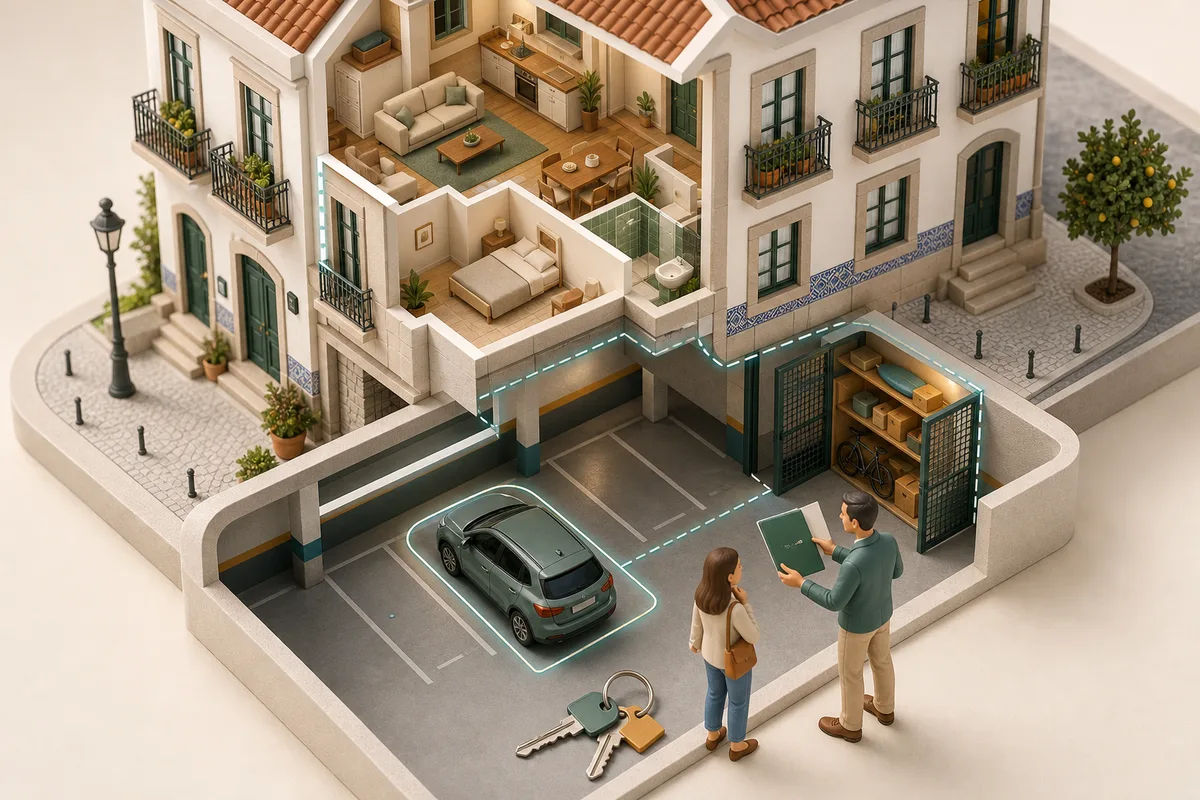
When a listing says "includes garage", "parking space" or "storage room", do not assume that what you saw is what you will buy. In a Portuguese condominium, that space may belong to the apartment fraction, be a separate autonomous fraction, be a common part allocated for exclusive use, or simply be informal use tolerated by the building.
For the buyer, the difference is practical: it can affect value, bank valuation, condominium charges, completion documents and whether you can use or sell that space later.
Key takeaways
- Check whether parking or storage appears in the registry certificate, tax record and horizontal-property title.
- A space used by the seller is not automatically a private right that can be sold.
- If the space is important to the price, identify it in the CPCV before paying a large deposit.
Why this changes the purchase
The common mistake is treating parking and storage as informal extras. The buyer visits the building, sees a painted bay on level -1, opens a storage room with the seller's boxes and concludes that everything is included.
The right question is different: which right is being transferred? In horizontal property, the autonomous fraction is a specific part of the building; other areas may be common parts. The horizontal-property title defines what corresponds to each fraction and its relative share.
Four cases that can look the same at the visit
Several legal situations can look physically identical. What changes is the document supporting the right.
| Situation | What it means | Buyer risk |
|---|---|---|
| Included in the apartment fraction | The registry certificate or title describes the fraction with parking, storage, bay or dependent area. | Lower, if the physical identification matches documents and plans. |
| Separate autonomous fraction | The garage or storage room has its own letter, tax article or registry description. | It must be included expressly in the CPCV, completion, taxes and mortgage process. |
| Common part with exclusive use | The space remains common, but the title or rules allocate use to one fraction. | The right may have limits; confirm it follows the apartment you are buying. |
| Informal use | The seller uses that bay because it has always been that way, but the paperwork is unclear. | You may lose the use, face a neighbour dispute or be unable to value the space. |
You do not need to classify the case alone. But you should require someone to classify it before the deposit: a lawyer, solicitor, notary, condominium manager or technical adviser who understands the building.
Documents to compare before the CPCV
Start with the normal purchase documents: land-registry certificate, tax record, horizontal-property title, plans, condominium information and, where relevant, the technical housing file or municipal file.
What to look for
- in the registry certificate: fraction description, annexes, garages, storage rooms, bays, letters and charges;
- in the tax record: article, fraction, private and dependent areas, use and tax titleholder;
- in the horizontal-property title: composition of each fraction, common parts, exclusive use and permillage;
- in the plans: location of the bay, garage, box, storage room, basement level and access;
- in condominium documents: use rules, relevant minutes, specific charges and any disputes;
- in the listing and offer: whether the space was promised as ownership, exclusive use or simple use.
If the garage is a separate autonomous fraction, confirm that the seller also owns that fraction and that it will be transferred. If you are using a mortgage, confirm with the bank whether the valuation, mortgage and completion documents include that space.
At the visit, confirm the exact physical space
After reading the documents, look at the building again. The goal is to connect the paperwork to the specific space.
Signs to check in the building
- number, letter or marking of the parking bay;
- door, key, remote or access to the garage;
- identification and floor of the storage room;
- actual limits of a garage box, open bay, locker or storage room;
- whether cars, objects or third-party occupation are in the space;
- whether the condominium manager confirms in writing that the space follows the fraction.
Be careful with phrases such as "this bay has always been ours", "everyone in the building knows" or "the old deed does not mention it, but there has never been a problem". It may be true. It may also be a dispute that only appears after completion.
How to protect yourself in the CPCV
If parking or storage is an important part of the decision, do not leave the promise only in the listing. The CPCV should say what is included, how it is identified and which documents prove the right.
Practical clauses to discuss
- identification of the main fraction and, if applicable, the autonomous garage or storage fraction;
- description of the bay, floor, number, letter, box or storage room according to the documents;
- delivery of the horizontal-property title and plans before the deposit or within a short deadline;
- seller statement that they have the right to transfer or associate that space;
- condition for satisfactory confirmation by the lawyer, solicitor, bank or condominium;
- clear consequence if the promised space cannot be transferred or used as advertised.
If the seller cannot prove the right before the CPCV, reduce the deposit, delay signing or write an objective condition. The worst result is paying an apartment-with-garage price and later discovering that you only bought uncertain use.
FAQ
Is the tax record enough to prove that the garage is included?
If the seller has used the bay for years, can I rely on that?
Does a separate garage fraction pay IMT and stamp duty?
Next step
Before paying the deposit, ask the seller one simple written question: "do the garage and storage room belong to the fraction, are they separate autonomous fractions, common parts for exclusive use or only spaces used informally?". If the answer does not come with documents, treat the issue as pending in the CPCV.
More guides
August 7, 2026
Damp and water ingress: investigate before the CPCV
How to record signs, diagnose the source, check the condominium and require proof of repair before buying a home in Portugal.
August 5, 2026
Electrical installation when buying: check before the CPCV
How to check the electrical file, condition, power capacity and responsibilities before buying a home in Portugal.